

faunely editorial team · Updated · 13 min read
In short
A pet hamster usually lives 18 months to 3 years. The Merck Veterinary Manual gives 18-36 months for Syrian hamsters, 18-24 months for Djungarian and Campbell's dwarfs, and 24-36 months for Chinese hamsters. Roborovski hamsters are the disputed case: Merck gives them 3-4 years, while a German veterinary reference gives only 1.5-2 years. Species matters, and so do a large enclosure with deep bedding, a pelleted diet and an early vet visit for diarrhea or weight loss.
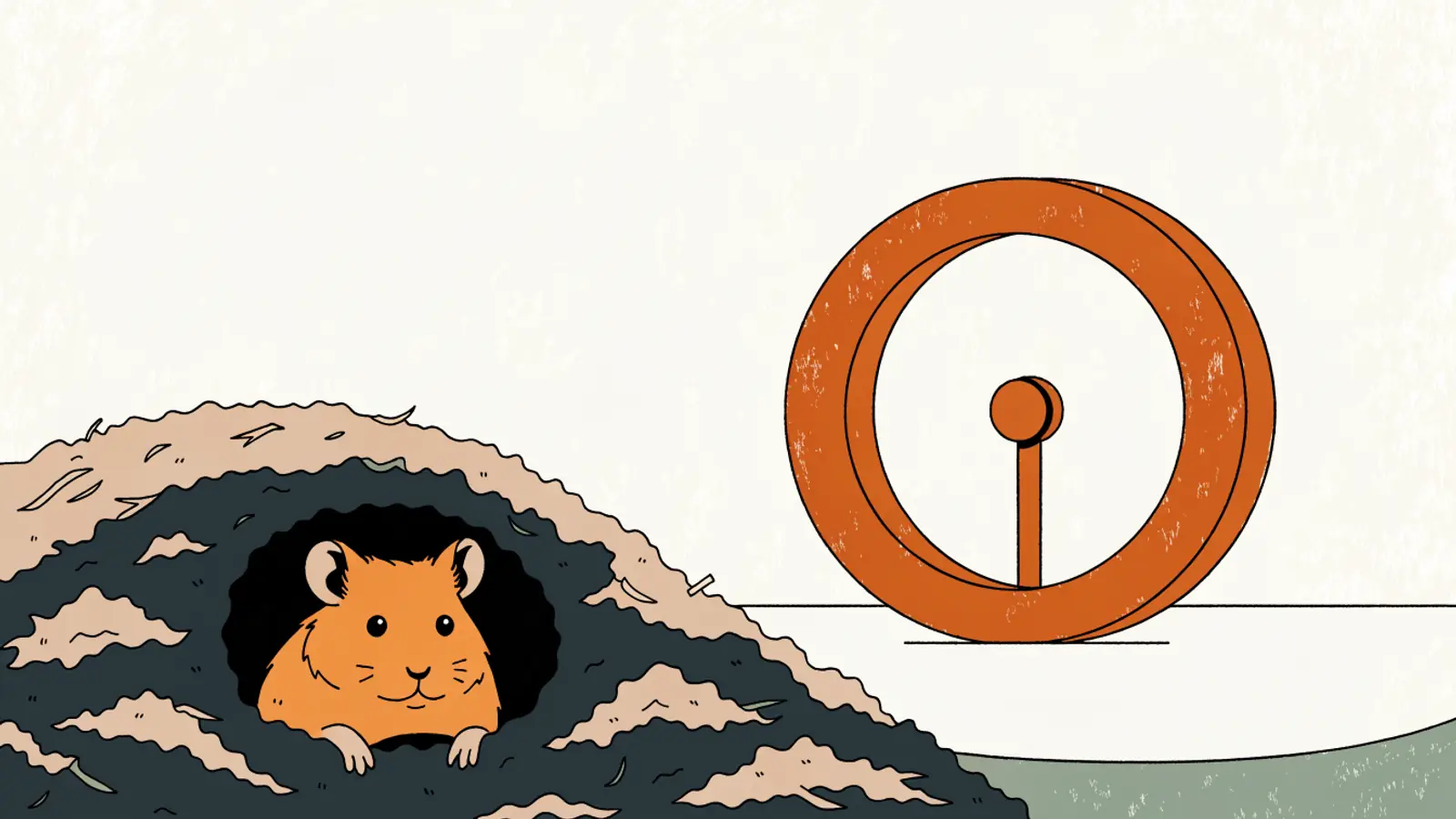
How long different hamster species live
Five species are common as pets. The Syrian (golden) hamster is the largest. The other four are called dwarf hamsters: the Djungarian or winter white (Phodopus sungorus), Campbell's (Phodopus campbelli), Roborovski (Phodopus roborovskii) and Chinese (Cricetulus griseus). The figures below come from veterinary references. An individual hamster can live a little less or a little longer; the reference gives the typical range.
| Species | Lifespan (Merck) | Maximum age (Ewringmann, Thieme) | Adult weight |
|---|---|---|---|
| Syrian | 18-36 months | not covered by this reference | 110-140 g |
| Djungarian | 18-24 months | 2-3 years | 30-50 g |
| Campbell's | 18-24 months | 2-3 years | 30-45 g |
| Roborovski | 36-48 months | 1.5-2 years | 20-30 g |
| Chinese | 24-36 months | 1.5-3 years | 30-45 g (Merck: 40-60 g) |
Merck groups the Djungarian and Campbell's hamster together as the "Russian dwarf". It lists Syrian hamsters at 110-140 g, with females larger than males.
For Roborovski hamsters the sources disagree. The Merck pet owner pages give 36-48 months, which would make them the longest-lived species. The German reference by Ewringmann and Glöckner (published by Thieme) lists a maximum age of 1.5-2 years, shorter than the Djungarian. Neither source explains the gap. Two to three years is a safe working figure for any species, and it makes sense to plan care as if your hamster will reach the upper end.
What size cage a hamster needs: floor space, bedding, wheel
Floor space for hamsters has been studied at the University of Bern. In 2007 Fischer and colleagues housed 60 female Syrian hamsters singly in cages of 1,800, 2,500, 5,000 and 10,000 cm². Stereotypic bar-gnawing appeared in every cage size, but hamsters in small cages gnawed longer and more often. The authors concluded that a floor of at least 10,000 cm² (about one square meter) improved welfare compared with smaller cages.
The UK veterinary charity PDSA says plainly that the evidence does not settle an exact cage size. It cites the German Veterinary Association for Animal Welfare (TVT), which sets a minimum floor of 100 × 50 cm. It is a minimum. A large single-level cage beats a tall multi-level one, because hamsters see poorly and fall easily.
How deep the bedding should be
Bedding depth was tested in Bern as well. In 2006 Hauzenberger and colleagues housed 45 male Syrian hamsters on wood shavings 10, 40 or 80 cm deep. At 10 cm the hamsters gnawed the wire far more. At 80 cm it was never seen. Every animal on 40 or 80 cm dug its own burrow and lived in it. The hamsters on the deepest bedding carried more fat, so the authors recommend deep bedding without insisting on the maximum. The professional section of the Merck manual cites this result: 40-80 cm of bedding improves Syrian hamster welfare.
Welfare charities give lower minimums. PDSA advises at least 25 cm. Paper bedding and mixes with hay hold burrows well. PDSA warns against dusty shavings and sawdust because of breathing problems, scented bedding, and newspaper because of the ink. Merck adds cedar and pine to the list of unsafe woods. Cotton wool and other fluffy nesting fibers are out entirely: strands wrap around legs and cause gut blockages if swallowed.
What wheel diameter to buy
A hamster in a wheel that is too small runs with an arched back. PDSA gives a minimum of 30 cm for Syrians and 20 cm for dwarfs. In the Bern cage-size study every cage had a 30 cm wheel, and the hamsters averaged 8.3 km per night. The running surface should be solid, with no rungs or mesh: Merck explains that feet and toes get caught in them. Merck allows exercise balls only briefly and under supervision, since a hamster inside one cannot eat or drink.
- Floor of at least 100 × 50 cm, larger if you can, and tall enough for 25 cm or more of bedding.
- Solid floor with no wire mesh, and a secure lid: hamsters are good at escaping.
- A hide or multi-chamber house, tubes, and cardboard to chew.
- A water bottle with a metal spout and a heavy ceramic bowl.
- Room temperature of 18-26 °C according to Merck (PDSA suggests 18-21 °C), away from drafts and direct sun.
Cold is dangerous. Below 5 °C Syrian hamsters often hibernate, and since they do not fatten beforehand they can starve if they fail to wake periodically to eat (Merck). PDSA describes a similar state, torpor, in hamsters that get too cold indoors.
Can two hamsters share a cage?
Syrian hamsters live alone. In the wild Syrian and Chinese hamsters are solitary and meet only to mate or to defend territory, and those fights end in injury or death (PDSA). Merck adds that adults can turn aggressive toward each other even if they grew up together, females especially.
Dwarf hamsters are also best kept singly. PDSA notes that Russian dwarfs live in small colonies in the wild, yet still advises against housing pet ones together because dominance fights are common. A single hamster does not get lonely. Males and females are never kept together: dwarf species reach sexual maturity at 4-8 weeks (Ewringmann, Thieme).
What to feed a hamster
The base of the diet is a complete pelleted hamster food. Merck suggests a rodent pellet with 15-20% protein. Muesli-style seed mixes are worse: hamsters pick out the seeds and sweet bits and leave the rest, which leads to obesity and dental trouble (Merck, PDSA). Fresh water must always be available, and the bottle should be checked daily.
Vegetables, herbs and fruit come in small amounts. Merck caps treats at 10% of the diet. PDSA puts the daily fresh portion at a teaspoon or two. Good choices include broccoli, cucumber, courgette, pumpkin, bell pepper, cauliflower, parsley and a piece of apple without seeds. A little boiled egg or a few mealworms now and then add protein. Introduce new foods gradually: the RSPCA warns that sudden diet changes and stale food upset digestion.
Foods hamsters should not eat
- Grapes and rhubarb, which the RSPCA calls poisonous to rodents.
- Onion, citrus, uncooked beans, tomato greens, almonds and peanuts (list from the AWLA shelter).
- Sugary pet-shop treat sticks and large amounts of seeds, which are high in sugar and fat.
- Unwashed fruit and vegetables.
- Human medicines and any antibiotics not prescribed by a vet: Merck warns that some antibiotics cause severe, sometimes fatal diarrhea in hamsters.
Sweet fruit is especially bad for dwarf hamsters: PDSA notes that Russian dwarfs are prone to diabetes and obesity.

Hamster teeth and cheek pouches
A hamster's incisors grow throughout life (Merck). The incisors wear down on hard food and safe chews such as wooden blocks, branches from unsprayed trees and cardboard. Overgrown teeth make eating hard. Watch for drooling, a poor appetite and weight loss. A vet trims overgrown teeth.
The cheek pouches open inside the lips and extend behind the shoulders. When full, they more than double the width of the head and shoulders (Merck). Hamsters use them to carry food and bedding to their stores. Merck includes a check for impacted pouches in a routine vet exam, along with the teeth. If one cheek stays swollen and never empties, take the hamster to a vet.
Common hamster illnesses: wet tail and other problems
"Wet tail" is the common name for diarrhea in hamsters. Its most serious cause in young Syrians aged 3-10 weeks is proliferative ileitis, a bacterial infection with high mortality (Merck). In adults diarrhea is often linked to Clostridioides difficile and can start 3-5 days after an unsuitable antibiotic. Stress from moving, crowding or a diet change raises the risk. PDSA lists the signs as diarrhea, a wet or soiled tail, poor appetite, lethargy, dehydration and sometimes sudden death. Merck warns that diarrhea dehydrates a hamster quickly and a vet may need to give fluids.
Other frequent problems listed by PDSA include wounds and abscesses from fights or sharp objects, hair loss from mites, ringworm, nutritional deficiency or tumors, and overgrown nails and teeth. Merck adds discharge from the eyes, ears or nose, a hunched back, an abnormal walk and trouble breathing to the signs of illness. Hamsters need no vaccines and none are recommended (Merck); AWLA advises a yearly vet check.
See a vet who treats rodents and exotic pets the same day for: wet or soiled fur under the tail, diarrhea, not eating or drinking, no droppings, labored or noisy breathing, marked lethargy, a hunched posture, drooling, limping or reluctance to move. A hamster is small, and dehydration from diarrhea sets in fast.
In Russia vets who specialize in rodents (often called ratologists, "ратолог") do not work at every clinic. Merck advises choosing a clinic with hamster experience and emergency care in advance, and a first check soon after you bring the hamster home: the vet examines the teeth, pouches, eyes, feet and belly and starts a medical record.
How hamsters age and what changes
Hamsters age fast, and age-related disease shows up in the second year. Atrial thrombosis affects up to 70% of aging Syrian hamsters. It develops at an average of 13.5 months in females and 21.5 months in males. Signs are fast breathing, a racing heart and a bluish tint. Untreated, the hamster usually dies within a week of these signs (Merck).
Weight loss in older Syrians is often tied to amyloidosis of the liver and kidneys. In laboratory studies it affected 80% of females over 18 months, though Merck notes it is reported infrequently in pet hamsters, which are not overcrowded. Liver cysts are found in hamsters over a year old, and kidney disease becomes more common with age. Djungarian hamsters develop tumors, mostly of the skin and mammary glands, five times as often as Syrians.
At home, an older hamster is helped by a low water bottle, food on the floor and gentle ramps instead of steep levels help. Weight loss in an old hamster should not be put down to age; a vet should look for the cause.
Why and how often to weigh a hamster
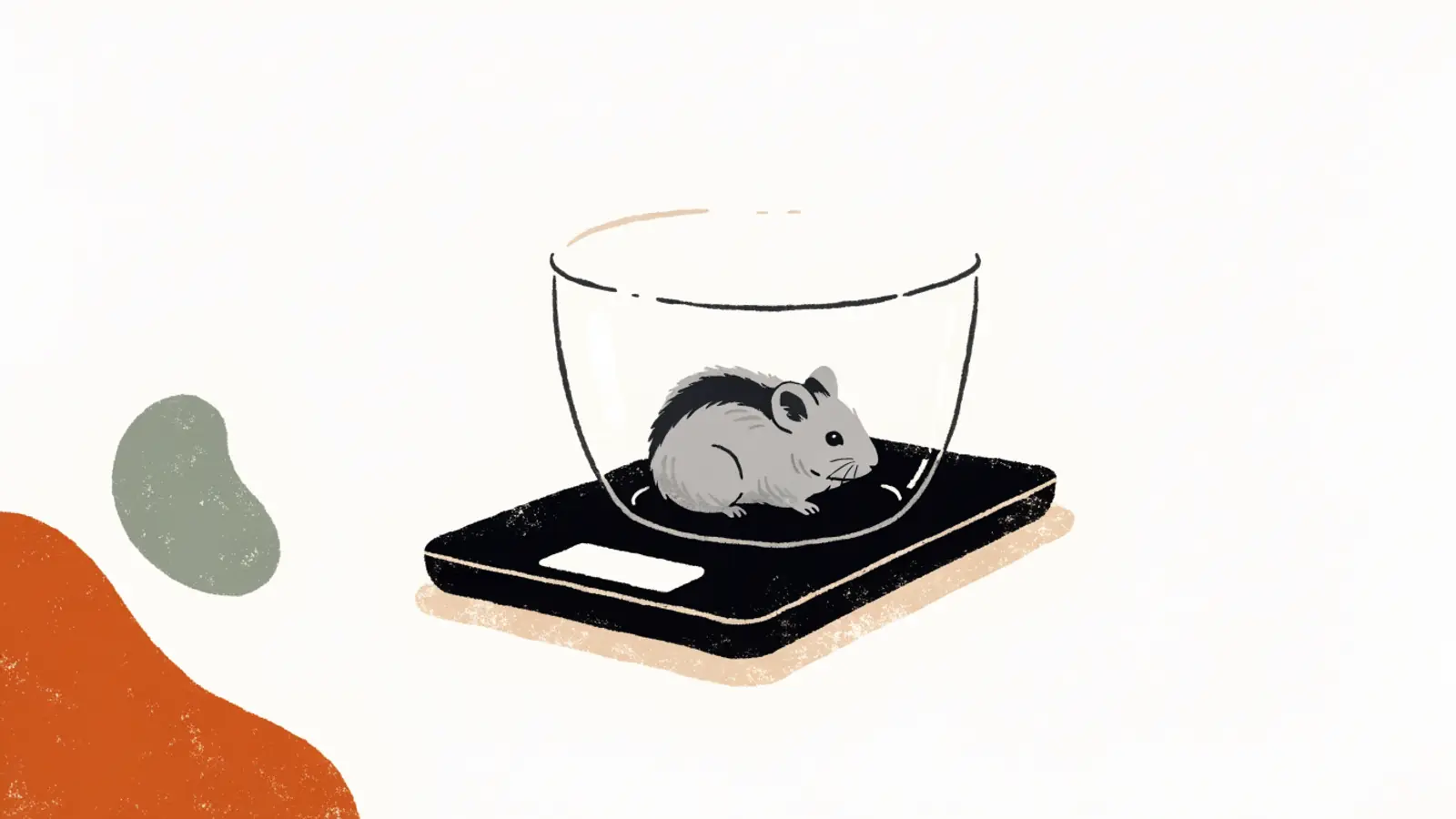
Weight loss is one of the first signs of illness in hamsters (Merck). You cannot see it: fur hides body shape, and food vanishing from the bowl only means it went into the hoard. The AWLA shelter advises weighing your hamster weekly to make sure its weight is stable.
- Use a kitchen scale that reads to 1 g. For a 25-40 g dwarf, a scale with 5 g steps is useless.
- Put a high-sided container on the scale and zero it.
- Place the hamster in the container in the evening, after it has woken up on its own.
- Write down the weight and the date. Weigh at the same time on the same scale.
- If the weight keeps falling for several weeks or drops sharply, take the hamster to a vet and bring your records.
Full cheek pouches add weight, so a single jump of a couple of grams means little. Look at the trend over several weeks. Take the first reading in the first days at home, while the hamster is healthy; without that baseline there is nothing to compare against.
Running hamster care day to day
Daily: fresh water, a check that the bottle works, removing wet bedding and leftover fresh food. Weekly: weighing and a look at the teeth, nails and the area under the tail. PDSA suggests a full clean weekly for a small cage and every few weeks for a large one. Put back some of the old dry bedding so the cage still smells familiar.
What to record: date of birth or estimated age at purchase, species, the first weight and weekly weights after that, the date of the first vet check and the contact details of a clinic that treats rodents. The next routine visit is due in a year; for an older hamster, follow the interval your vet sets. Faunely can store weight records and remind you of recurring tasks such as weekly weighing and the full clean.
Common questions
How long do pet hamsters live?
Usually 18 months to 3 years. Merck gives 18-36 months for Syrians and 18-24 months for Djungarian and Campbell's dwarfs. Species, genetics, a large cage with deep bedding and prompt treatment of diarrhea and other illness all affect the result.
How long do Djungarian (winter white) hamsters live?
About 18-24 months according to Merck. The German reference by Ewringmann and Glöckner lists a maximum age of 2-3 years. Russian dwarfs are prone to diabetes and tumors, so keep sweet fruit to a minimum and never ignore weight loss.
How long do Syrian hamsters live?
18-36 months according to the Merck owner pages, and 2-3 years in the professional section of the same manual. Atrial thrombosis develops about 8 months earlier on average in females than in males, and amyloidosis is more common in females.
What can hamsters eat besides pellets?
Small amounts of vegetables and herbs such as broccoli, cucumber, courgette, pumpkin and parsley, plus an occasional bit of boiled egg or a few mealworms. Merck keeps treats under 10% of the diet. Grapes, rhubarb, onion, citrus and uncooked beans are off the menu.
How long do Roborovski hamsters live?
The sources disagree. Merck gives 36-48 months, while the German reference by Ewringmann and Glöckner gives a maximum of 1.5-2 years. It is the smallest species, at 20-30 g as an adult, so weight tracking needs a scale that reads to 1 g.
Do hamsters need vaccinations?
No. Vaccines are neither required nor recommended for hamsters (Merck, VCA). What they need is a vet check soon after you get them, then a yearly exam (AWLA).
Why does my hamster chew the cage bars?
Usually because the cage is too small or the bedding too shallow. In the University of Bern studies hamsters gnawed the bars less in cages of about 1 m² and not at all on 80 cm of bedding.
Keep the schedule in faunely
Add your pet, mark what has been done, and faunely will remind you about the next step in Telegram.
Start a pet diarySources
- Hamsters (Exotic and Laboratory Animals). Merck Veterinary Manual
- Description and Physical Characteristics of Hamsters. Merck Veterinary Manual
- Providing a Home for a Hamster. Merck Veterinary Manual
- Routine Health Care of Hamsters. Merck Veterinary Manual
- Heimtier-Infos: Zwerghamster (after Ewringmann, Glöckner. Leitsymptome bei Hamster, Ratte, Maus und Rennmaus). Thieme Tiermedizin
- Behaviour of golden hamsters (Mesocricetus auratus) kept in four different cage sizes. Animal Welfare, 2007
- The influence of bedding depth on behaviour in golden hamsters (Mesocricetus auratus). Applied Animal Behaviour Science, 2006
- Hamsters as pets. PDSA
- What to feed hamsters. RSPCA
- Caring for Hamsters. Animal Welfare League of Arlington
More articles
- Guinea pigs: lifespan, diet and everyday careGuinea pigs live 4 to 8 years on average. How much vitamin C and hay they need, cage size, and when to see a vet, based on Merck, RSPCA and PDSA guidance.
- Rabies vaccination for dogs and cats in Russia: timing, legal duty, paperworkWhether Russian Order No. 705 makes the rabies shot mandatory, the age for the first dose, booster interval, pet passport entries and when titers are needed.
- Vaccination schedule for puppies and adult dogsFirst puppy shot at 6-8 weeks, last dose of the series at 16 weeks or later, another at 26 weeks. Rabies in Russia from 3 months, then yearly.