

faunely editorial team · Updated · 14 min read
In short
The owner writes their own details and the animal's description: name, species, breed, sex, date of birth and coat, ideally in Russian and in Latin letters. The microchip, vaccinations, parasite treatments and the clinical examination are entered only by a veterinarian, with a sticker, date, signature and stamp. To travel within Russia a dog or cat needs a valid rabies vaccination and a state vet's examination mark made no more than 14 days before departure. The passport is valid for the animal's life and is replaced when its pages run out.

What a Russian pet passport is and whether you need one
Under the Eurasian Economic Union's unified veterinary requirements (Customs Union Commission Decision No. 317, annexes 2 and 3), the animal veterinary passport identifies a dog or cat kept by an owner for personal use. It is a 26-page booklet measuring 15 by 10 cm. Entries are handwritten in blue or black ink, in Russian and, where needed, in English. The passport stays valid for the animal's whole life.
These rules do not make a passport compulsory just because you keep a cat at home: the document is issued "at the owner's initiative". In practice you need one as soon as the animal travels. Rosselkhoznadzor, Russia's veterinary watchdog, names the passport with a current rabies vaccination as the only document required to move a dog or cat around Russia by air, rail or car.
According to the filling rules, a state veterinarian issues the passport unless national law says otherwise, and only for an identified animal, meaning one with a microchip or tattoo. Blank booklets come from many printers and are sold in clinics and pet shops. The cover does not matter; the sections inside do.
What the passport is for: travel, shows, and the F1 and F4 certificates
Veterinary accompanying documents (VSD in Russian) are governed by Ministry of Agriculture Order No. 862 of 13 December 2022, in force from 1 September 2023 to 1 September 2029, which replaced Order No. 589. Point 21 of those rules says no VSD is needed when a pet moves without a change of owner and not for business. Shows and sports competitions are the exception.
Veterinary certificate Form No. 1 (F1) covers journeys within Russia, and veterinary note Form No. 4 (F4) covers trips within a city or district. Both are issued electronically in the federal VetIS system, in its Mercury module; on request the owner shows the document number, its QR code or a printout. A VSD is valid for five days before the journey and until it ends.
- You need an F1 when the owner changes, when the animal goes to a show, and when it has no passport at all.
- Rosselkhoznadzor allows kittens and puppies under 3 months without a rabies shot to travel only with an F1.
- For countries outside the former Soviet region, the state animal disease station (SBBZh) issues an F1, which Rosselkhoznadzor then exchanges for a Form 5a certificate.
- For EAEU countries (Belarus, Kazakhstan, Armenia, Kyrgyzstan) you get a Customs Union veterinary certificate Form No. 1 instead.
To issue any of these, the state vet needs a passport showing rabies and other vaccinations, deworming and identification, plus your route. The certificate cannot be issued sooner than 20 days after the rabies vaccination. If the booster was given while the previous one was still valid, there is no wait. In Moscow and the Moscow region an F1 also requires a faecal test for worm eggs from an accredited lab, done no more than five days before the trip.
Passport sections: who fills them in and what to write
Section numbers and titles below follow the passport form in Decision No. 317. Booklets from individual printers may order them differently, but the fields are almost the same.
| Section | Who fills it in | What to write |
|---|---|---|
| I. Owner | The owner supplies the details and may write them | First name, surname, address, postcode, city, country, phone; up to three owners |
| II. Description of the animal | Owner, or the vet from the owner's words | Name, species, breed, sex, date of birth, coat colour and type in Russian and English; photo optional |
| III. Identification | The vet who implanted the chip | Chip number sticker, implant date, site (withers), tattoo, distinguishing marks, neutering |
| IV. Rabies vaccination | Only a vet authorised to vaccinate against rabies | Vaccine sticker with batch and expiry, date, "valid until", signature and stamp |
| V. Rabies antibody titre | A vet, after an accredited lab result | Blood sampling date, laboratory, result of at least 0.5 IU/ml; only if the destination requires it |
| VI. Ectoparasite treatment | Veterinarian | Product and manufacturer (sticker or handwritten), date, signature and stamp |
| VII. Deworming | Veterinarian | Product, manufacturer, treatment date, signature and stamp |
| VIII. Other vaccinations | Veterinarian | Vaccine sticker, date, validity, signature and stamp |
| IX. Clinical examination | A vet, usually a state vet at the SBBZh | "Clinically healthy" mark, destination, date, signature and stamp |
| X. Checks in transit | State veterinarian only | Marks for checks made along the route |
| XI. FeLV and FIV (cats) | Veterinarian | Feline leukaemia and immunodeficiency test results; if the destination requires them |
| XII. Notes | Veterinarian | Additional identification and health details |

The filling rules contradict themselves here. Point 11 assigns sections I–III to the veterinarian, while point 12 says the owner provides the section I details. Rabbits Leaving Russia, a volunteer wiki on moving pets abroad, goes by practice: owners may write their own details and the pet's description themselves. The medical sections are for the vet.
How to enter your dog's or cat's details correctly
Owner
Write your name as it appears in your international passport, if you have one: "Александр / Aleksandr". Address, city and country are worth duplicating in Latin letters too. Everyone listed in the owner lines counts as an owner and may transport the animal and obtain certificates for it. If a relative will take the cat, add them as a second owner; if you run out of lines, writing between them is accepted.
Description of the animal
- Name: in Cyrillic and Latin letters with a slash, for example "Пушок / Pushok". A long name can go in Latin letters only.
- Species: "собака / dog", "кошка / cat". Words meaning "canids" or "felids" name a family and count as a mistake.
- Breed: from the pedigree or obvious breed traits. Without a pedigree, for a rescued stray or for a designer cross such as a maltipoo, leave it out or write "метис / mixed breed".
- Sex: "самец / male" or "самка / female".
- Date of birth: from the pedigree; otherwise an estimate. The EAEU form marks this field "as stated by the owner".
- Coat: colour and coat type, for example "серый, короткошёрстный / gray, short hair". For cats, "tabby", "tuxedo" and "calico" work.
- Distinguishing marks: dewclaws, a torn ear, a scar, patches untypical for the breed.
Write legibly, in block letters. If the passport is already filled in only in Russian, add the Latin version beside it after a slash instead of rewriting the lines.
How to record a microchip in the passport
Almost every country accepts ISO 11784/11785 microchips. Their number has 15 digits: Russian chips start with country code 643, chips imported from China often with 900. The chip holds no owner name or implant date; a scanner shows only the number.
After implanting, the vet checks the chip with a scanner, sticks the number label in the identification section, writes the date and site (usually the withers) and stamps over the label with the clinic stamp. The number is written by hand only in the rare case when the label is lost. On the EAEU form, identification has to be recorded before any new entry in the passport.
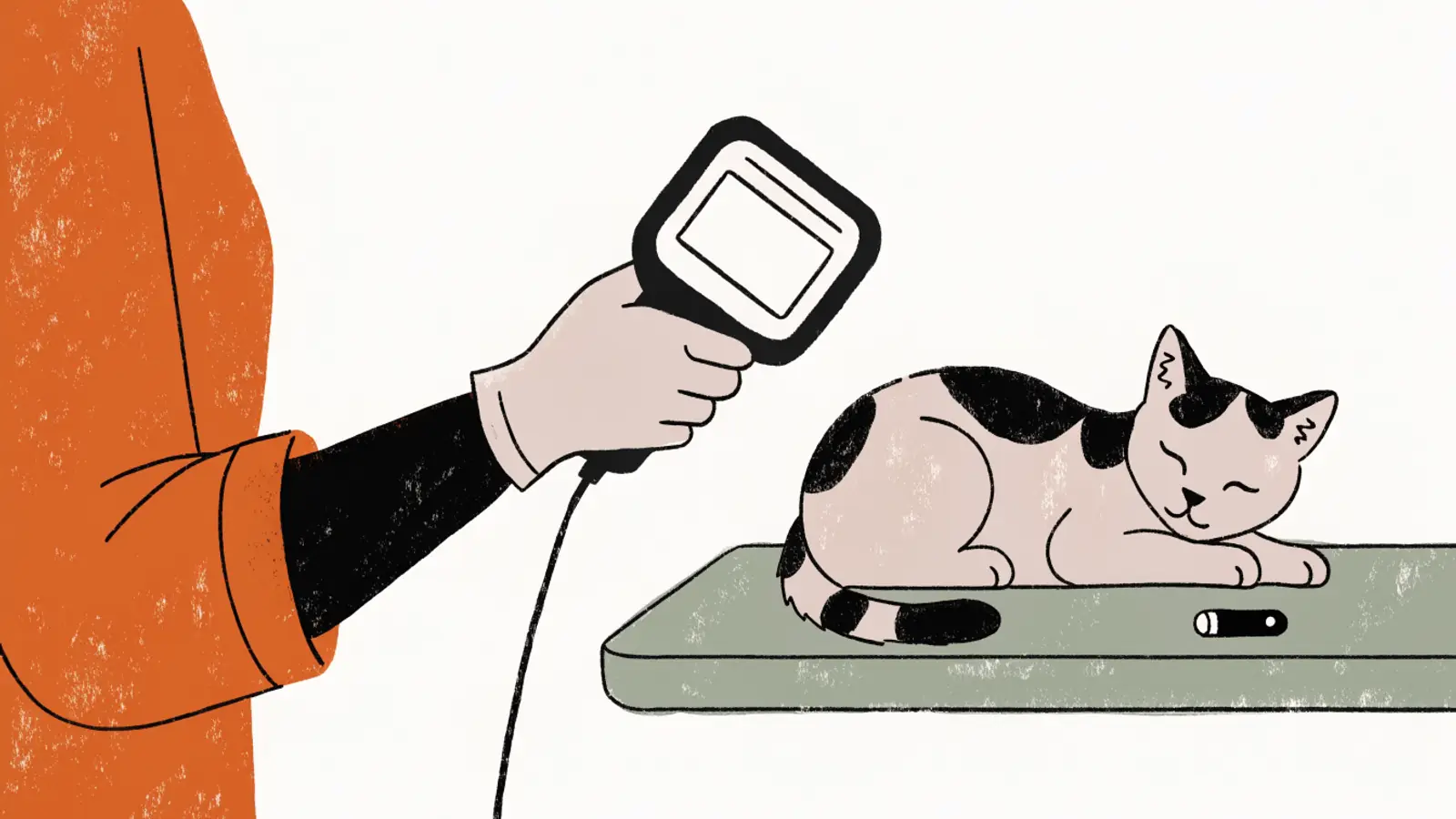
For the EU, the order of dates matters: the rabies vaccine must not be given before the chip. If your cat was vaccinated this year and chipped only now, the vaccination has to be repeated. Registering the chip in a database is not needed to leave Russia: Russian databases are private, and border officers only compare the label number with the chip. If a chip stops reading, scan the whole body first, because chips can migrate. If it is not found, a new chip is implanted and its label goes next to the old one.
Vaccinations, treatments, clinic stamps and vaccine stickers
The rabies line must carry the vaccine sticker with batch and expiry, the vaccination date, the end of validity, and the vet's signature and stamp. Only a vet makes this entry. Rosselkhoznadzor reminds owners that rabies and other vaccinations are given every year unless the vaccine's instructions say otherwise; when no end date is written, it is assumed to be one year later. A private clinic may give the rabies vaccine as well as a state one.
For travel, rabies vaccinations must run without gaps: under EAEU rules each rabies booster has to be given while the previous vaccination is still valid. Then the 21-day wait after vaccination does not apply. If there was a gap between shots, the count starts again.
Flea, tick and worm treatments are entered with the product name and manufacturer, as a sticker or by hand, with a date, signature and stamp. Owners may note home deworming for their own records, but a treatment before going abroad must be certified by a vet. The clinical examination mark at the SBBZh is made by a state vet no more than 14 days before the trip; within the EAEU it allows movement for 120 days, as long as the rabies vaccination does not expire in that time.
The international-style passport: how it differs
Russian rules do not set a separate domestic model: the EAEU form covers travel inside the union and export. What people call an international passport is a bilingual booklet with every field labelled in Russian and English and with sections for antibody titres and clinical examination. Up to two dogs or cats travelling for personal use can enter EAEU countries on such a passport, which counts as a veterinary certificate.
For other countries the passport alone is not enough: on its basis Rosselkhoznadzor issues a Form 5a certificate, an EU health certificate or the destination country's own form. The Rabbits Leaving Russia wiki recommends a booklet with room for several owners and clinical examination pages. When the vaccination pages are full, start a new passport and have the latest entries copied over; keep the old one and carry it if a rabies titre test was done on it.
The EU pet passport: what it is and who issues it
An EU pet passport is issued by an authorised vet in an EU country. You can tell it by the blue cover with yellow stars and a number starting with the country code. With it, a dog, cat or ferret moves between EU countries without extra certificates. The European Commission says the passport is intended only for pets whose owners habitually live in the EU. Since 22 April 2026, Delegated Regulation (EU) 2026/131 applies, with a new passport model in Implementing Regulation (EU) 2026/705. Passports on the old 577/2013 model stay valid if issued before 22 April 2026, or before 1 January 2028 under transitional rules.
A vet outside the EU, Russia included, may not fill in the old-model passport's sections on microchipping (III), rabies vaccination (V), titres (VI) or clinical examination (X); such an entry invalidates the document. A Russian vet may record tapeworm and other parasite treatments (VII, VIII), other vaccinations (IX) and section XII. According to the wiki, the passport itself costs about 10 euros plus about 10 euros for issuing, while a full visit with examination and vaccination can reach 250 euros.
Filling mistakes that get a certificate refused
- A rabies vaccination without a sticker, date or stamp, or certified by a breed club or kennel rather than a vet.
- An expired vaccination, or one given after a gap, with fewer than 20 days since it for a domestic certificate or 21 days for travel abroad.
- For the EU, a rabies vaccination given before the chip was implanted.
- A label number that differs from what the scanner shows, or a chip that cannot be read.
- Species written as a family, name and coat only in Cyrillic, a breed stated without grounds.
- The person travelling with the animal is not listed as an owner and has no power of attorney.
- A pre-departure parasite treatment noted by the owner without a vet's signature; Finland, Ireland, Malta, Norway and Northern Ireland also require a tapeworm treatment.
- A clinical examination mark older than 14 days.
How much a veterinary passport for a cat or dog costs
No law sets the price of the booklet: state animal disease stations approve their own price lists, and private clinics set theirs. For example, the price list of the state station in the Nenets Autonomous Okrug charges 110 roubles to issue a passport and 820 roubles for microchipping. Vaccines, the consultation and any VSD are paid separately, so a first visit with a chip and a vaccination costs more than the booklet.
Keeping the passport up to date: what to note and when to act next
After every visit, check that the passport has a sticker, date, signature and stamp, and note three dates separately: when the rabies vaccination expires, the next core vaccination and the next parasite treatment. Give the rabies booster before the current one runs out so continuity is not lost. Before a trip, book the SBBZh examination inside the 14-day window, and get the VSD five days before departure if you need one.
Photograph the chip and vaccination pages and keep the copy apart from the passport. In faunely you can add these dates as recurring procedures and get Telegram reminders before they are due.
Common questions
Can I fill in the veterinary passport myself?
Partly. The owner may write their own details and the animal's description, legibly and preferably with Latin letters too. The chip, vaccinations, treatments and clinical examination are entered only by a vet, with a sticker, signature and stamp.
Does an indoor cat need a veterinary passport?
The EAEU rules describe the passport as a document issued at the owner's initiative. You need it for travel, shows and certificates, and as the record of rabies vaccination.
How do I fill in a dog's passport in the international style?
Write each description field in Russian and Latin letters with a slash: "Шарик / Sharik", "собака / dog", "самец / male". The chip label goes into the identification section before the rabies entry. The vet fills in the remaining sections.
How does the EU pet passport differ from a Russian international one?
Only an authorised vet in the EU issues it, and only to owners who habitually live in the EU. The content is similar, but the chip, rabies, titre and examination sections may be completed only by an EU vet.
What if the passport runs out of pages?
Get a new passport and ask the vet to copy over the latest vaccinations and treatments. Keep the old one, especially if a rabies antibody titre test was recorded in it.
Do I need an F1 certificate to take my dog on a train within Russia?
No, if you are the owner and the dog is not going to a show or a new home. You need the passport with a valid rabies vaccination and a state vet's examination mark made within the last 14 days.
Keep the schedule in faunely
Add your pet, mark what has been done, and faunely will remind you about the next step in Telegram.
Start a pet diarySources
- Procedure for completing the animal veterinary passport (Annex 3 to the Unified Veterinary Requirements). Customs Union Commission, Decision No. 317
- Order No. 862 of 13 December 2022 on veterinary accompanying documents. Ministry of Agriculture of Russia
- How to travel with a pet within Russia. Rosselkhoznadzor
- How to travel abroad with animals. Rosselkhoznadzor, Krasnoyarsk office
- Rules for transporting animals within Russia and abroad. Moscow Government
- International veterinary passport: filling instructions. Rabbits Leaving Russia
- Microchipping. Rabbits Leaving Russia
- EU pet passport. Rabbits Leaving Russia
- Travelling with a pet within the EU. European Commission
- Price list: other veterinary services. Nenets Autonomous Okrug State Animal Disease Station
More articles
- Rabies vaccination for dogs and cats in Russia: timing, legal duty, paperworkWhether Russian Order No. 705 makes the rabies shot mandatory, the age for the first dose, booster interval, pet passport entries and when titers are needed.
- Vaccination schedule for puppies and adult dogsFirst puppy shot at 6-8 weeks, last dose of the series at 16 weeks or later, another at 26 weeks. Rabies in Russia from 3 months, then yearly.
- Healthy dog weight: how to tell if your dog is in shapeAdult dog weights from FCI breed standards, the WSAVA 1–9 body condition score, when puppies stop growing and which weight loss is a concern.