

faunely editorial team · Updated · 15 min read
In short
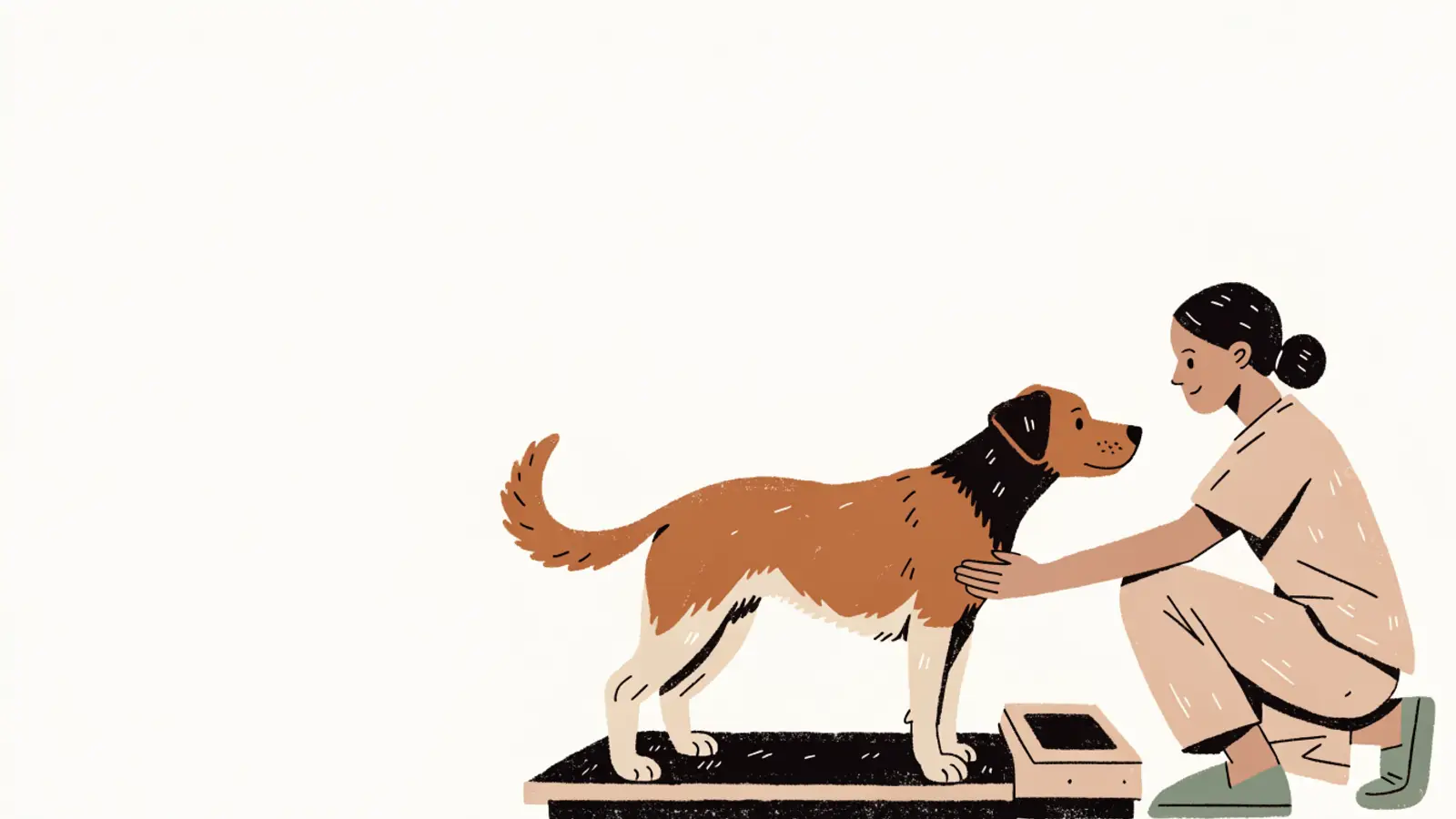
There is no single healthy weight for dogs: under FCI standards a Chihuahua weighs 1 to 3 kg and a male Rottweiler about 50 kg. What a particular dog should weigh is judged by body condition. On the WSAVA 9-point scale the ideal is 4–5: ribs are easy to feel, the waist is visible from above, and the belly tucks up from the side. Each point above 5 means roughly 10% excess weight, and losing more than 10% of body weight without a diet counts as clinically significant.
Why there is no single healthy weight for dogs
Dogs vary in size more than any other domestic species. The authors of a growth-chart study (Salt et al., 2017) give a range from a Chihuahua of about 1 kg to a St Bernard of 115 kg. With that spread, an average dog weight tells you nothing about your own dog.
Weight also varies within a breed. Breed standards nearly always separate males and females: a male German Shepherd should weigh 30–40 kg and a female 22–32 kg. Build matters too. Two females of the same height with different bone and muscle can differ by several kilograms and both be in good shape.
A breed standard describes the show ideal, which is a different thing from a medical norm. Many standards give no weight at all, only height at the withers. That is why the WSAVA guidelines ask vets to look at three measures together: body weight, body condition score (BCS) and muscle condition score. For an individual dog, a healthy weight is the weight at which it scores 4–5 out of 9.
How much an adult dog weighs: breed chart
The Russian Kynological Federation (RKF) is a full member of the FCI and publishes Russian translations of FCI standards, so the same figures apply in Russia. The table covers common breeds. For four of them the standard gives only height or chest girth.
| Breed (FCI standard number) | Weight in the standard | Height at withers |
|---|---|---|
| Chihuahua (218) | 1-3 kg, ideal 1.5-2.5 kg | Not considered, only weight is judged |
| Yorkshire Terrier (86) | Up to 3.2 kg | Not stated |
| Jack Russell Terrier (345) | About 1 kg per 5 cm of height: 5-6 kg | 25-30 cm |
| Cavalier King Charles Spaniel (136) | 5.4-8 kg | Not stated |
| Pug (253) | Ideal 6.3-8.1 kg | Not stated |
| French Bulldog (101) | Males 9-14 kg, females 8-13 kg | Males 27-35 cm, females 24-32 cm |
| Pembroke Welsh Corgi (39) | Males 10-12 kg, females 9-11 kg | About 25-30 cm |
| Siberian Husky (270) | Males 20.5-28 kg, females 15.5-23 kg | Males 53.5-60 cm, females 50.5-56 cm |
| German Shepherd (166) | Males 30-40 kg, females 22-32 kg | Males 60-65 cm, females 55-60 cm |
| Rottweiler (147) | Males 50 kg, females about 42 kg | Males 61-68 cm, females 56-63 cm |
| Labrador Retriever (122) | Not stated | Males 56-57 cm, females 54-56 cm |
| Golden Retriever (111) | Not stated | Males 56-61 cm, females 51-56 cm |
| Beagle (161) | Not stated | 33-40 cm |
| Dachshund (148) | Not stated, size is set by chest girth | Standard Dachshund chest girth: males from 37 to 47 cm, females from 35 to 45 cm |
Standard figures work as a guide for an adult purebred dog. The French Bulldog standard allows 500 g over the limit if the dog is typical of the breed. The Siberian Husky standard says weight must be in proportion to height and penalises any appearance of excess weight. For Labradors, Beagles and mixed breeds there is no figure, and the body condition score is all you have.
How to tell if your dog is overweight: body condition score
The WSAVA Global Nutrition Committee uses a 9-point body condition score. Scores 1–3 mean underweight, 4–5 ideal, and 6–9 overweight. The WSAVA guidelines warn that a dog in ideal condition may look too thin to its owner. In the studies WSAVA cites, disease risk starts to rise above a score of 6.
The 2021 AAHA guidelines link the scores to excess weight: each point above 5 equals roughly 10% over ideal body weight, and each step on the scale adds about 5% body fat.
| Score | What you see and feel | Weight relative to ideal |
|---|---|---|
| 1 | Ribs, lumbar vertebrae and pelvic bones visible from a distance. No body fat, obvious muscle loss | Below ideal |
| 2 | Ribs, lumbar vertebrae and pelvic bones easily visible, no palpable fat, minimal muscle loss | Below ideal |
| 3 | Ribs easy to feel and may be visible, with no fat over them. Tops of lumbar vertebrae visible, pelvic bones prominent, obvious waist and tuck | Below ideal |
| 4 | Ribs easy to feel under minimal fat. Waist easily seen from above, abdominal tuck clear from the side | Ideal |
| 5 | Ribs felt without excess fat. Waist visible behind the ribs from above, belly tucked up from the side | Ideal |
| 6 | Ribs felt under slight excess fat. Waist visible from above but not prominent, tuck still present | About +10% |
| 7 | Ribs hard to feel under heavy fat. Fat over the lower back and tail base, waist barely visible or gone | About +20% |
| 8 | Ribs not felt, or felt only with firm pressure. Heavy fat over the lower back and tail base, no waist, no tuck | About +30% |
| 9 | Massive fat over the chest, spine and tail base, fat on the neck and legs. Belly visibly distended | +40% or more |
How to check ribs, waist and belly
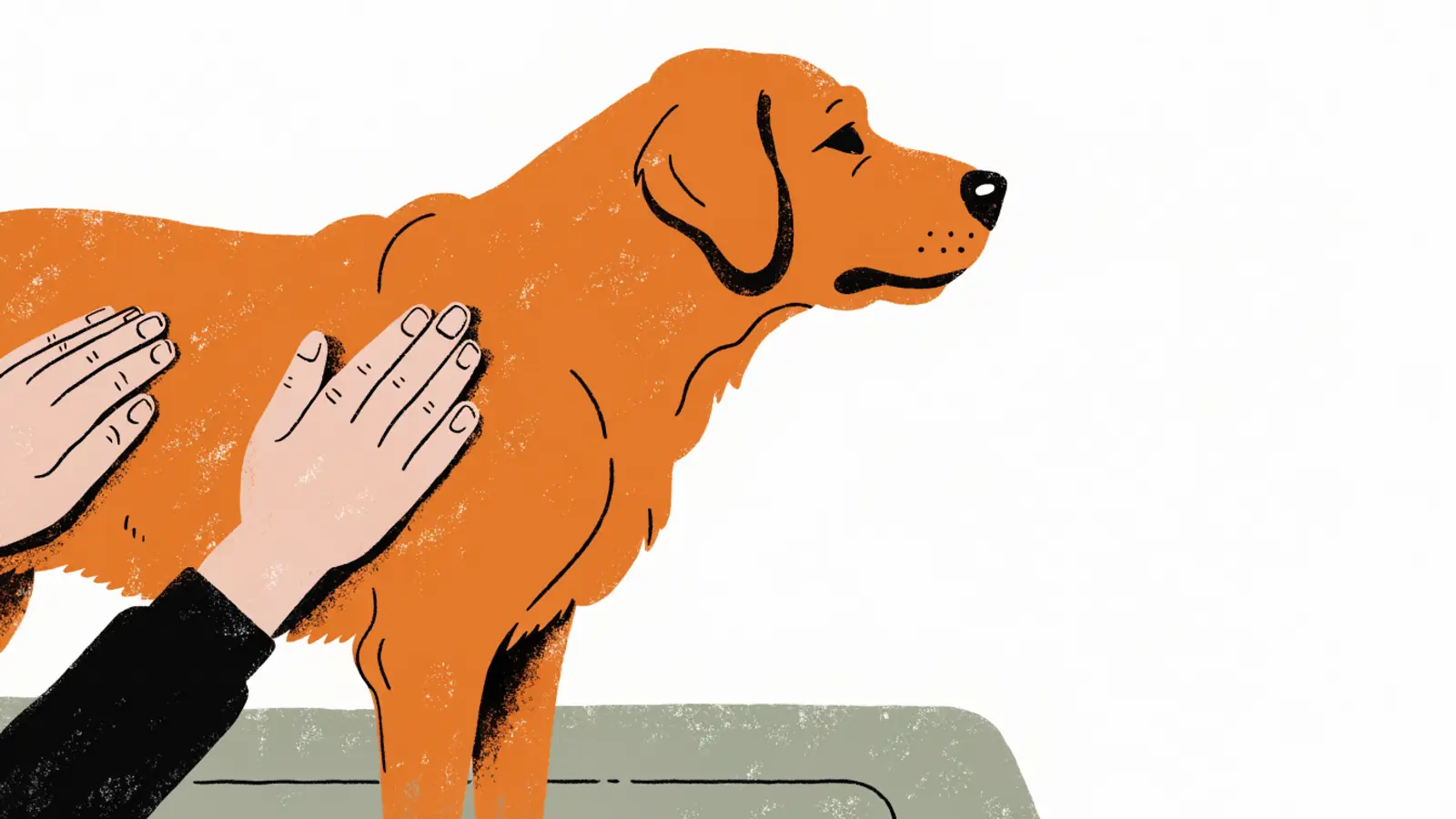
- Stand the dog square and lay your palms flat on both sides of the chest behind the shoulder blades. Run your fingers over the ribs with light pressure, as if stroking. At a score of 4–5 you feel each rib at once without pressing.
- Look down at the dog from above. Behind the last ribs the body should narrow before the hips: that is the waist. If the sides run straight or bulge, the score is above 5.
- Look from the side. The belly line should rise from the chest towards the groin. A flat or sagging belly appears at scores 8–9.
- Run a hand over the lower back and the base of the tail. The WSAVA chart describes soft fat pads in these places from a score of 7.
- Check the muscle over the spine, shoulder blades, skull and pelvis separately. WSAVA rates it on its own muscle condition scale: an older or sick dog can lose muscle even while carrying extra fat.
In fluffy or long-coated dogs your eyes will mislead you, so do the assessment mostly by hand. Record the score with the weight: the two numbers together show whether a dog is gaining muscle or fat.
When a puppy reaches adult weight
Growth speed depends on adult size. According to the literature reviewed by Salt et al. (2017), very small dogs reach adult weight at 8–12 months, while large breeds need up to 24 months.
The same team built growth charts from records of more than 6 million young dogs seen at US clinics. They found that a size category was enough to assess growth, and that breed-specific curves were not needed. There are five categories based on expected adult weight: under 6.5 kg, 6.5–9 kg, 9–15 kg, 15–30 kg and 30–40 kg. The charts do not apply to dogs heavier than 40 kg.
Puppies are overweight less often than adults, but the problem does not go away by itself. In a study of nearly 4.9 million dogs (Montoya et al., 2024), 9.5% were overweight in late growth. Dogs recorded as overweight while growing had 1.85 times the odds of being overweight as adults.
How to weigh your dog at home
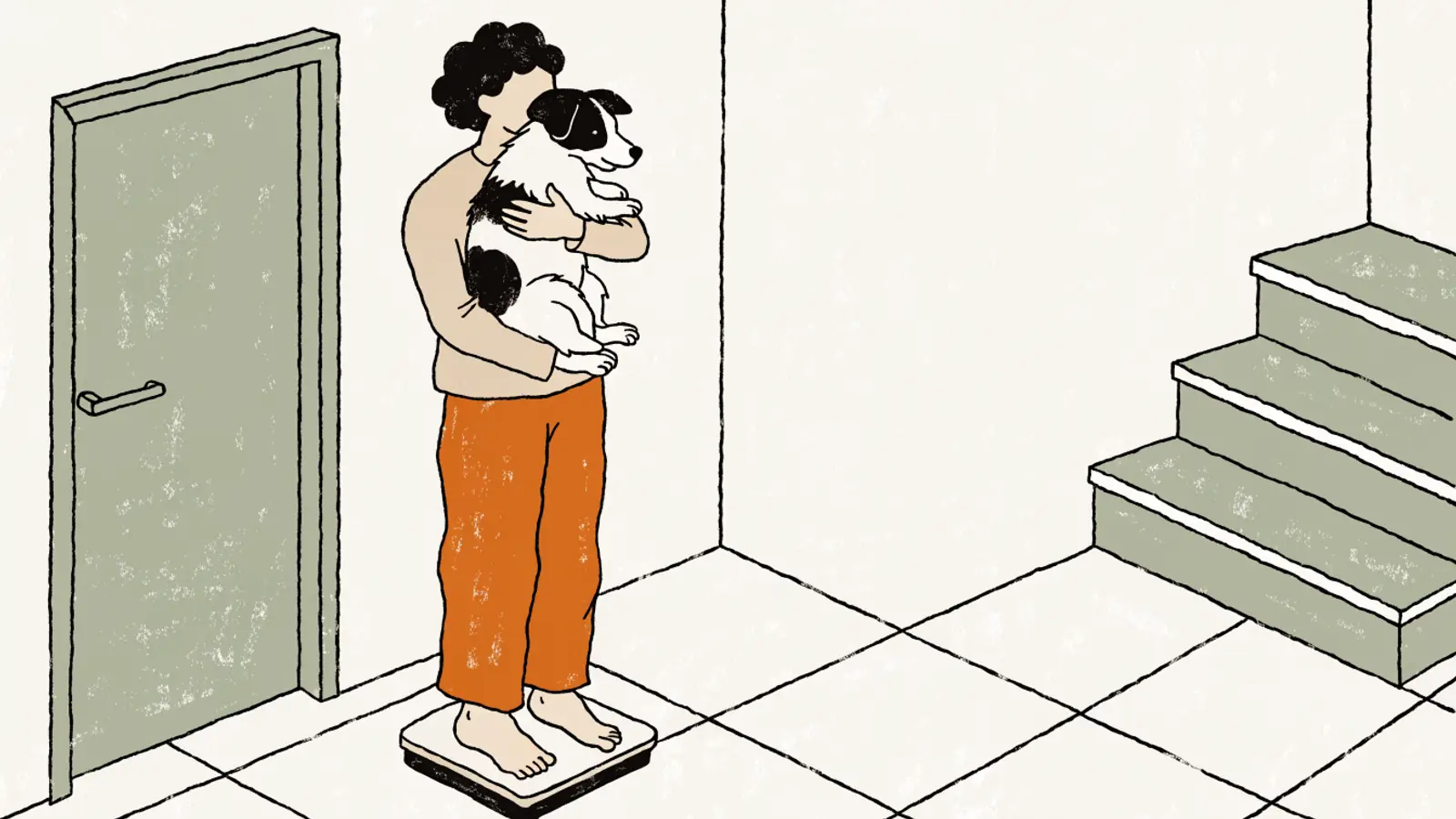
A small dog is easiest to weigh on a bathroom scale with you. Step on the scale holding the dog and note the number. Then weigh yourself straight away and subtract your weight from the total. If the dog struggles, do not hold it by force, as you can both fall.
A dog of a couple of kilograms is better weighed on a kitchen or baby scale that reads to tens of grams. If a puppy will not sit still, weigh it inside a carrier, then weigh the empty carrier. A large dog you cannot lift is weighed on the floor scale at a veterinary clinic.
- Use the same scale every time. Different scales can give different readings, and the chart will then show a change that never happened.
- Put the scale on a hard, level floor, not on a rug.
- Pick one time of day, for example in the morning before food and after a walk.
- Take off a collar with heavy tags, the harness and any clothing.
- Write the weight down at once, with the date and which scale you used.
The WSAVA guidelines ask vets to measure weight, body condition and muscle condition the same way each time so that changes over time are visible. The same rule applies at home.
How much weight change is a concern
Weight change is easier to judge as a percentage than in kilograms: the same 500 g means one thing for a toy terrier and another for a Central Asian Shepherd. The formula is simple: the difference between the previous and current weight, divided by the previous weight and multiplied by 100. A dog that went from 20 kg to 18.8 kg has lost 6%.
A client handout from the VCA hospital network treats weight loss as clinically significant when a dog loses more than 10% of its normal weight and the loss is not due to dehydration. For a 32 kg retriever that is more than 3.2 kg. The faster the loss, the bigger the concern. The WSAVA checklist lists any unexplained weight change, up or down, as a risk factor that calls for a fuller nutritional assessment by the vet.
When a dog is losing weight on a vet's plan, the Merck Veterinary Manual gives about 1% of body weight per week as a reasonable rate, with a weigh-in every 2 weeks. Faster loss, especially with muscle loss, should be discussed with the vet.
Take your dog to a vet promptly if it has lost more than 10% of its weight without a diet, or if it is losing weight while refusing food, vomiting, having diarrhoea, drinking a lot and urinating often.
Why excess weight is harmful for dogs
The Merck Veterinary Manual defines a dog as overweight at 10–20% above ideal weight and obese at more than 20%. By the same source, more than half of the dogs and cats seen by US vets are heavier than they should be. In the large US study by Montoya et al. (2024), 44.5% of adult dogs were overweight and another 8.4% obese. In the mature life stage these shares rose to 50.1% and 12.6%.
Merck lists the health effects of obesity as shorter life and lower quality of life, chronic inflammation, breathing and heart problems, poor tolerance of exercise and heat, arthritis and other joint disease, weaker immunity, pancreatitis and higher risk under anaesthesia. Fat tissue produces hormones and other substances that keep up low-grade inflammation, which is linked to osteoarthritis and diabetes.
Two studies show the effect on lifespan. In the trial by Kealy et al. (2002), 48 Labradors were split into pairs, and one dog in each pair was fed 25% less throughout life. Median lifespan in the restricted dogs was 13 years against 11.2, and their chronic diseases started later. Salt et al. (2019) studied 50,787 neutered pet dogs of 12 breeds: in every breed, dogs that were overweight in middle age lived shorter lives. The gap ranged from 5 months in male German Shepherds to 2 years and 6 months in male Yorkshire Terriers. The study was observational, so it does not prove cause and effect.
Breeds differ in how easily they gain weight. Merck names Labradors, Miniature Schnauzers, Dachshunds, Shetland Sheepdogs, Cocker Spaniels, Beagles, Basset Hounds and Cairn Terriers among breeds at higher risk. Other risk factors include too little exercise, age, neutering, some endocrine diseases and certain drugs.
How weight relates to feeding amounts
The amount on a food label, or the calorie target a vet calculates, is a starting point. Merck says plainly that the calculation has to be adjusted to how the animal responds. If the body condition score climbs on the chosen portion, the dog is getting too much. If the weight drops and the ribs start to show, it is getting too little.
Treats, table food and food used to give pills should not exceed 10% of daily calories: WSAVA and Merck both use this limit. After neutering, a change in activity or a move, review the portion against fresh weigh-ins. A specific amount for an overweight or ill dog is the vet's job to calculate.
How to keep a weight chart for your dog
Each time you weigh, record the date, the weight, which scale you used and the body condition score. Add a note for events that explain jumps: a food change, illness, a season, neutering, the start of a weight-loss plan. Weigh at a fixed interval. Weigh a puppy more often, so the points can be compared with the growth curve for its size category, and a dog on a diet every 2 weeks, as Merck suggests.
Look at the direction of the line and the percentage change, not a single number. A 10% gain over six months in an adult dog on the same portion means roughly one extra body condition point. A printout or screenshot of the chart is easy to show the vet at an appointment.
In faunely a dog's weight goes into the diary and is shown as a chart, and regular weigh-ins can be added to the care plan with a Telegram reminder.
Common questions
How much should my dog weigh?
For a purebred dog, the FCI breed standard gives a guide if it states a weight. The body condition score is more precise: the right weight is the one at which your dog scores 4–5 out of 9. For mixed breeds and breeds without a weight in the standard, there is no other method.
How do I calculate my dog's ideal weight?
You can estimate it from the body condition score: according to AAHA, each point above 5 equals about 10% excess weight. A 33 kg dog scoring 7 is about 20% over ideal, so its ideal weight is around 27.5 kg (33 divided by 1.2). This is a rough estimate, and a target weight is best confirmed with a vet.
What is the average weight of a dog?
No average weight applies to every dog: breeds range from 1 kg to 115 kg. Size categories are more useful, as in the study by Salt et al. (2017): under 6.5 kg, 6.5–9 kg, 9–15 kg, 15–30 kg, 30–40 kg and over 40 kg.
Until what age does a puppy gain weight?
Small dogs reach adult weight at 8–12 months, while large breeds keep growing until about 24 months. While a puppy grows, its weight is compared with the growth curve for its expected adult size.
Why did my dog gain weight after neutering?
Merck lists neutering as a risk factor for obesity. If a dog is fed the same as before the operation, it often puts on weight. Review the portion against weigh-ins and the body condition score in the first months after surgery.
I can see my dog's ribs. Is that normal?
Faintly visible ribs on a short-coated dog can occur at a score of 4, which the AAHA chart describes as the lower edge of ideal. If the ribs, lumbar vertebrae and pelvic bones are easy to see and no fat can be felt, the score is 3 or lower, which is underweight. A sudden drop to that state needs a vet visit.
Keep the schedule in faunely
Add your pet, mark what has been done, and faunely will remind you about the next step in Telegram.
Start a pet diarySources
- Body Condition Score: Dog. WSAVA Global Nutrition Committee
- WSAVA Nutritional Assessment Guidelines. WSAVA, Journal of Small Animal Practice
- 2021 AAHA Nutrition and Weight Management Guidelines: Screening Evaluation. American Animal Hospital Association
- Nutrition in Disease Management in Small Animals. Merck Veterinary Manual
- FCI Breeds nomenclature and standards. Fédération Cynologique Internationale
- Growth standard charts for monitoring bodyweight in dogs of different sizes. PLOS One (Salt et al., 2017)
- Overweight and obese body condition in ~4.9 million dogs and ~1.3 million cats seen at primary practices across the USA. Preventive Veterinary Medicine (Montoya et al., 2024)
- Association between life span and body condition in neutered client-owned dogs. Journal of Veterinary Internal Medicine (Salt et al., 2019)
- Effects of diet restriction on life span and age-related changes in dogs. JAVMA (Kealy et al., 2002)
- Abnormal Weight Loss in Dogs. VCA Animal Hospitals
More articles
- Rabies vaccination for dogs and cats in Russia: timing, legal duty, paperworkWhether Russian Order No. 705 makes the rabies shot mandatory, the age for the first dose, booster interval, pet passport entries and when titers are needed.
- Vaccination schedule for puppies and adult dogsFirst puppy shot at 6-8 weeks, last dose of the series at 16 weeks or later, another at 26 weeks. Rabies in Russia from 3 months, then yearly.
- Flea and tick treatment for dogs and cats: how often and whenHow often to treat dogs and cats for fleas and ticks, when to start in spring in Russia, the babesiosis risk, and why dog spot-ons can kill cats.