

faunely editorial team · Updated · 16 min read
In short
A dog or cat that goes outdoors needs uninterrupted tick protection for the whole season when ticks are active. In central Russia ticks wake up in early April, once the mean daily air temperature reaches +1 to +3 °C, and earlier in the south. The product label sets the interval: a month for most spot-ons and tablets, 12 weeks for some tablets, several months for a collar. ESCCAP advises year-round protection when the risk is high, while an indoor-only cat usually needs regular checks with a flea comb.

How often to treat a dog for fleas and ticks
There is no single number for every animal. The European Scientific Counsel Companion Animal Parasites (ESCCAP) bases the plan on lifestyle: where the animal walks, how many pets share the home, whether it has flea allergy. The interval between treatments comes from the duration of action of the specific product, as stated on its label. If protection is meant to be continuous, the next dose is due on the day the previous one runs out, not whenever someone remembers.
As a rough guide, the Merck Veterinary Manual lists most flea and tick spot-ons and tablets as 30-day products, a few tablets and spot-ons as 12-week products, and collars lasting up to 8 months, less with frequent bathing. The range sold in Russia differs from the US one, so always check the label of the product you actually bought. ESCCAP suggests checking the animal towards the end of the protection period: a live tick means the next treatment is due early.
| Situation | How often to treat | Source |
|---|---|---|
| Dog walks in parks, forest or at a dacha; cold, snowy winters | Without gaps for the whole tick season, at the label interval | ESCCAP GL3, table 5 |
| Warm region, or ticks established indoors, in a kennel or run | Year-round | ESCCAP GL3, table 5 |
| High risk of tick-borne disease: hunting, babesiosis area | Year-round; products with repellent action help | ESCCAP GL3, table 5 |
| Risk of both fleas and ticks | Usually monthly with a product against both, plus cleaning of bedding | ESCCAP GL3, table 5 |
| Cat or dog with regular outdoor access (fleas) | Regular prevention at the product interval, daily vacuuming | ESCCAP GL3, table 2 |
| Multi-pet home, shelter, breeder, hunting dogs | Year-round, all animals at once, plus treatment for immature stages indoors | ESCCAP GL3, table 2 |
| Flea allergy dermatitis | Long-term with no gaps, every animal in the home | ESCCAP GL3, table 2 |
| Indoor-only cat | Flea comb checks; treatment if fleas or a tick are found | ESCCAP GL3, tables 2 and 5 |
| Trip to an area with many ticks | Regularly for the whole trip, starting before departure | ESCCAP GL3, section 2.5 |
| Travel abroad | As the destination country requires, recorded with a vet's signature and stamp | rabbitsleavingrussia.wiki |
Year-round or only during tick season
For ticks, ESCCAP accepts a seasonal plan where winters are clearly cold, as long as protection covers the entire period when ticks are active. Year-round treatment is advised in warm regions, with constant reinfestation risk, and where tick-borne disease risk is high. ESCCAP also notes that the ornate dog tick Dermacentor reticulatus, the main vector of canine babesiosis in Europe, has been found questing in winter in Germany.
Fleas are less seasonal. Infestations peak in summer and autumn, yet they occur in every month. In a centrally heated flat with carpets, larvae keep developing whatever the season. A winter break from flea treatment makes sense only when the animal has no contact with other animals or the places they use during that time.
For central Russia, with its snowy winters, that translates into tick protection from spring until steady frosts. If the dog lives in a house with other animals, or travels south in winter, a year-round plan is worth discussing with the vet.
When ticks are active in Russia and when to start
According to Rospotrebnadzor, Russia's public health agency, ixodid ticks become active in spring when the snow melts and the mean daily air temperature reaches +1 to +3 °C. They are fully active from about +10 °C. In central Russia that is usually early April; in the south it comes sooner. After a warm, snowless winter, isolated tick bites on people were reported in January in the Krasnodar and Stavropol regions, Crimea and the Rostov region.
Autumn matters for dogs as well. A 2026 review of canine babesiosis in Russia (Bulletin of KSAU) places the peaks in spring, from late April to early June, and in autumn, from August to October. So the first treatment should go on before the first warm walk through grass, and the last one should not be dropped in September just because summer is over.

Why ticks are dangerous for dogs: babesiosis
For dogs in Russia, the main tick-borne threat is babesiosis, also called piroplasmosis. The parasite Babesia canis lives in red blood cells and destroys them. ESCCAP names the ornate dog tick Dermacentor reticulatus as its main vector in Europe. The same Bulletin of KSAU review reports that babesiosis accounts for 14 to 18% of all dogs seen by vets, with infection rates ranging from 12% to 75% across regions.
A female tick usually needs 24 to 48 hours of feeding before Babesia reaches the dog's blood with its saliva. That is why a tick should come off as soon as you find it. The margin is not guaranteed: ESCCAP notes that male ticks, which feed repeatedly in small amounts and may move between hosts, can transmit faster.
The Federation of European Companion Animal Veterinary Associations (FECAVA) lists the signs: lethargy, depression and fever, pale mucous membranes sometimes with pinpoint bleeding, jaundice, brown or dark orange urine, rapid breathing. Severe cases progress to shock, kidney failure or seizures. The disease can be mild and brief or fulminant, and a blood test is needed to confirm it. ESCCAP considers tick-borne disease less of a problem in cats than in dogs, but ticks on cats are still removed and controlled with cat products.
See a vet the same day if, during tick season, your dog becomes lethargic, refuses food, runs a fever, has pale or yellowish gums, passes urine the colour of strong tea or coffee, or breathes fast. You do not need to have found a tick: it may have been missed or already dropped off. Tell the vet where you walked and when the dog was last treated.
Fleas and worms: the Dipylidium link
Fleas carry the tapeworm Dipylidium caninum. A flea larva in the home eats the tapeworm's eggs, the intermediate stage develops inside it, and the adult flea becomes infective. A dog or cat swallows it while nibbling at an itchy spot. ESCCAP gives about three weeks until the adult worm matures. Owners usually notice white, moving segments the size of a rice grain in fresh faeces, in the fur around the anus or on the bedding.
ESCCAP states plainly that Dipylidium is prevented by controlling fleas and lice. If fleas turn up, ask the vet about a dewormer that covers tapeworms. If you see those segments, fleas have probably been around. How often dogs and cats should be dewormed is covered in the article on deworming frequency; that schedule is separate from flea and tick treatment.
Fleas keep coming back because of their life cycle. A female lays about 20 eggs a day, and the eggs fall off the animal onto floors, into carpets and cracks. Adult fleas on the pet are a small share of the whole population in the home. Development from egg to adult takes anywhere from 14 to 140 days, and a fully formed flea can wait in its cocoon for six months or more. Hence the ESCCAP rule: treat every dog and cat in the home at the same time, vacuum where they sleep and wash their bedding.
Spot-on, tablet or collar: which to choose
The form of the product changes convenience and everyday handling more than the principle of protection. The choice is made with a vet, taking into account species, weight, age, pregnancy or lactation and other illnesses. Below are general principles without brand names.
- Spot-ons go on the skin between the shoulder blades, where the animal cannot lick them off. ESCCAP warns that shampooing and swimming can reduce the effect of topical products, so check bathing advice on the label.
- Tablets work from the inside, so the bathing that ESCCAP links to weaker topical products is not an issue. Many cats are harder to pill than to dose with a spot-on, and International Cat Care advises choosing what you can manage regularly.
- Collars are designed to last several months, but only work while worn and fitted snugly. For cats, International Cat Care recommends only collars advised and sold by a vet practice, not any collar from a pet shop.
- Sprays suit animals that cannot use other forms, and are also used on areas where flea larvae live. International Cat Care does not recommend powders.
- Products with repellent action stop ticks from attaching. ESCCAP sees this as an advantage where rapidly transmitted tick-borne infections are a risk. Products without it kill the tick after attachment and still protect against infections transmitted late in feeding.
Not every product suits kittens, puppies, or pregnant and nursing animals. International Cat Care advises checking that the pack clearly names that group. A dog product is never used on a cat, even in a smaller amount.
Why dog flea spot-ons are dangerous for cats
Many dog spot-ons contain permethrin or other synthetic pyrethroids at high concentration. ESCCAP specifically warns that concentrated pyrethroids registered only for dogs are toxic to cats. A cat's liver cannot break permethrin down, so it builds up in the body.
International Cat Care calls permethrin one of the most common causes of cat poisoning worldwide. Most often the owner applies a dog product to the cat. The other route is a cat rubbing against a recently treated dog or sharing a sofa with it. If there is a cat in the home, choose a permethrin-free product for the dog; if you do use one, keep the dog and cat apart for 72 hours.
Call a vet immediately if a dog product has been put on your cat or the cat has been in contact with a freshly treated dog. International Cat Care lists the signs: tremors, twitching, oversensitivity to touch and sound, a wobbly gait and, in severe cases, seizures. Do not wait for symptoms.
How often to treat an indoor cat that never goes outside
ESCCAP places cats with no outdoor access in the minimal-risk group. For them it recommends regular grooming with a fine flea comb, with treatment only when fleas or a tick are found. In that case the product is repeated at the label interval until both adult fleas and their larvae in the home are gone.
Things change if a dog in the same home goes outdoors: all animals are treated, or the cat stays a flea reservoir. The same applies to a cat with flea allergy dermatitis, which needs long-term protection. A cat taken to the dacha for the summer, or let out into an enclosure with grass, counts as an outdoor cat for that period.
Checking a cat is easy. ESCCAP calls combing the most sensitive way to detect fleas. If no fleas are visible, put the combings on a damp white tissue: flea droppings look like black specks and spread a reddish ring of undigested blood.
How to remove a tick from a dog or cat
Remove a tick as soon as you find it. ESCCAP recommends purpose-made tick removal tools and warns against putting oil, alcohol or ether on the tick. The US Centers for Disease Control and Prevention (CDC) describes the tweezer method, which works on animals too.
- Part the fur and grasp the tick with fine-tipped tweezers as close to the skin as possible, without squeezing its body.
- Pull with steady, even pressure and no jerking. With tweezers, do not twist, or the mouthparts may break off. Tick hooks have their own technique, described in their instructions.
- If the mouthparts stay in the skin and the tweezers cannot get them, leave them: the skin will push them out as it heals.
- Do not crush the tick with your fingers. Put it in a sealed container or wrap it tightly in tape so it cannot reach another animal.
- Clean the bite and wash your hands with soap. Check the whole animal, as a tick rarely comes alone.
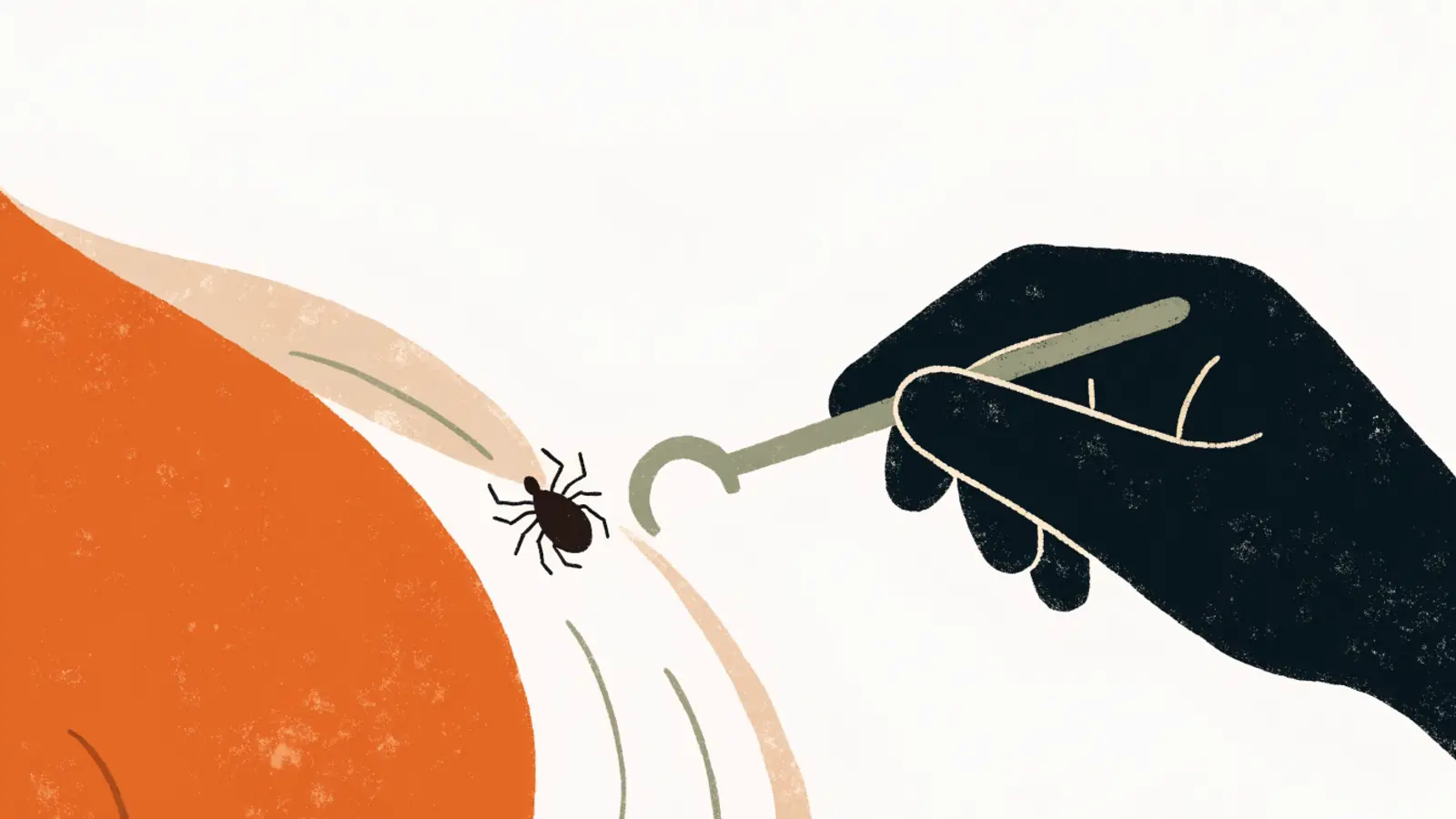
After removal, ESCCAP suggests treating the animal with an acaricide, since small larvae and nymphs are easy to miss, and keeping up prevention for the rest of the season. Over the following days and weeks, watch the dog's behaviour, appetite and urine colour.
What parasite treatment travel requires
If a dog is going somewhere with many ticks and endemic tick-borne diseases, ESCCAP advises treating it regularly for the whole trip, especially against diseases that do not occur at home. For a trip to southern Russia, plan the treatment so protection is active from day one.
For travel abroad, the destination country sets the rules, and flea and tick treatment is required in far from every case. According to the rabbitsleavingrussia.wiki summary, Argentina and Brazil require treatment for external and internal parasites within 15 days before the documents are issued, the UAE within 14 days and Puerto Rico within 72 hours. In the EU, the only official requirement is echinococcus treatment for dogs entering Finland, Malta, Ireland and Norway, given 24 to 120 hours before arrival.
A treatment counts for travel only if the vet passport carries the vet's signature and stamp. It is often done at a state veterinary clinic (SBBZh) when the Form 1 veterinary certificate is issued, five days or less before departure. If a product has no passport sticker, the vet writes its name by hand. The wiki authors suggest putting only travel treatments in the passport and keeping routine ones elsewhere, so the passport does not run out of space before a trip.
How to keep a schedule and not miss the next dose
Tick protection only works when there are no gaps between treatments. After each one, write down the date, the product form and its duration of action from the label, and work out the next date straight away. In spring it helps to mark the first treatment in advance, tied to snowmelt where you live; in autumn, keep going until steady frosts.
In a multi-pet home it is easier to treat everyone on the same day. Note findings separately: a tick, fleas, segments in faeces. Each one is a reason to shift the schedule, give a dewormer or see a vet. In faunely you can set up a recurring treatment with the right interval, and the app will remind you of the next date in Telegram.
Common questions
How often should I apply a flea spot-on to my cat?
As often as the label says: once a month for most products, every 12 weeks for some. Applying it more often does not add protection. An indoor-only cat usually does not need routine spot-ons; comb checks and treatment when fleas are found are enough.
How often should a dog be treated for fleas, ticks and worms?
These are two separate schedules. Flea and tick treatment follows the product's duration of action, through the tick season or all year. ESCCAP recommends deworming one to twelve times a year depending on risk, and it does not have to coincide with tick treatment.
When should tick treatment start in spring?
Before the first walks through grass after the snow melts. Rospotrebnadzor reports that ticks wake up at a mean daily temperature of +1 to +3 °C, which in central Russia is usually early April. In the south the season starts earlier, sometimes as early as January after a warm winter.
Does a dog need tick treatment in winter?
Usually not in regions with cold, snowy winters, unless the dog travels south. Protection is needed during thaws in warm regions and when ticks live indoors. ESCCAP mentions that the ornate dog tick, the babesiosis vector, can be active in winter.
My dog is treated but a tick still attached. What now?
Remove the tick and watch the dog. Many products kill a tick only after it attaches, so a bite alone does not mean the product failed. Lethargy, fever or dark urine mean an urgent trip to the vet.
Can I use a dog product on my cat if I reduce the amount?
No. Dog spot-ons containing permethrin are dangerous to cats even in small amounts, and they are a common cause of cat poisoning. Use only a product clearly labelled for cats.
Should I treat the kennel or flat for fleas?
Yes, with a heavy infestation. Most of the flea population lives as eggs, larvae and cocoons where the animal sleeps, so ESCCAP advises daily vacuuming, washing bedding and, where needed, products against immature stages indoors. If ticks have settled in a kennel or run, ESCCAP recommends treating it with a compound from a different chemical group.
Keep the schedule in faunely
Add your pet, mark what has been done, and faunely will remind you about the next step in Telegram.
Start a pet diarySources
- GL3: Control of Ectoparasites in Dogs and Cats. ESCCAP
- GL5: Control of Vector-Borne Diseases in Dogs and Cats. ESCCAP
- MG1: Worm Control in Dogs and Cats (Dipylidium caninum). ESCCAP
- Ectoparasiticides Used in Dogs and Cats. Merck Veterinary Manual
- Babesiosis in dogs. FECAVA
- Babesiosis of dogs distribution in the Russian Federation (review). Bulletin of KSAU (Krasnoyarsk State Agrarian University)
- Permethrin poisoning. International Cat Care
- Rospotrebnadzor on the upcoming tick season (in Russian). Rospotrebnadzor, Kaliningrad Region office
- What to Do After a Tick Bite. CDC
- Parasite treatment (in Russian). Rabbits Leaving Russia wiki
More articles
- Rabies vaccination for dogs and cats in Russia: timing, legal duty, paperworkWhether Russian Order No. 705 makes the rabies shot mandatory, the age for the first dose, booster interval, pet passport entries and when titers are needed.
- Vaccination schedule for puppies and adult dogsFirst puppy shot at 6-8 weeks, last dose of the series at 16 weeks or later, another at 26 weeks. Rabies in Russia from 3 months, then yearly.
- Healthy dog weight: how to tell if your dog is in shapeAdult dog weights from FCI breed standards, the WSAVA 1–9 body condition score, when puppies stop growing and which weight loss is a concern.