

faunely editorial team · Updated · 15 min read
In short
Kittens get their first combination shot against panleukopenia, herpesvirus and calicivirus at 6-8 weeks, repeated every 2-4 weeks until they are 16 weeks old or older. WSAVA advises the next dose at 26 weeks, about 6 months; many clinics give it at one year instead. After that, a low-risk cat gets the core vaccine every 3 years, and cats that go outdoors or into boarding more often, up to yearly. In Russia cats are vaccinated against rabies from 3 months of age and then every year.
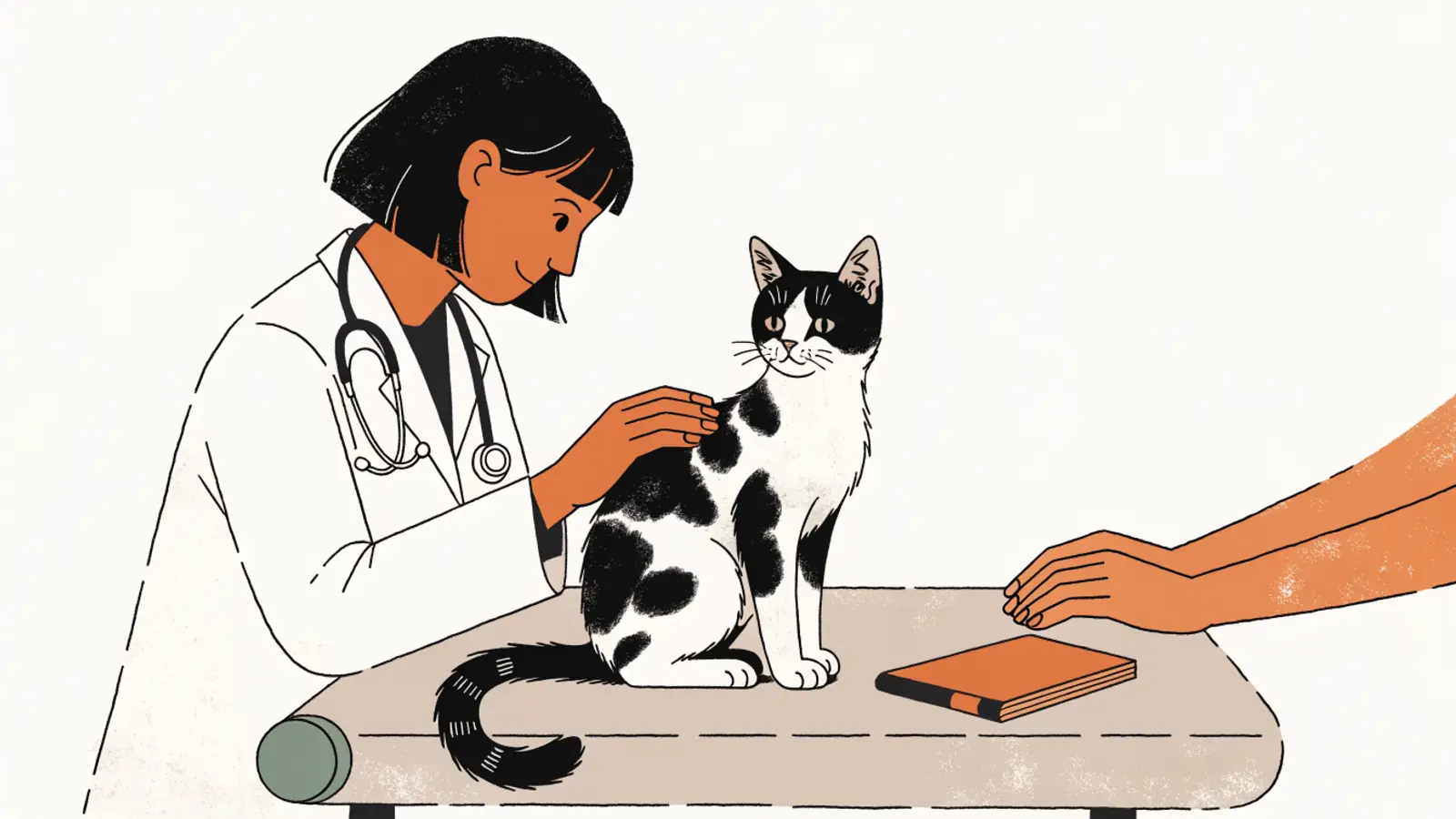
Which vaccines does a kitten or cat need
The World Small Animal Veterinary Association (WSAVA) splits vaccines into core and non-core. Every cat should receive the core ones, wherever it lives. For cats these protect against panleukopenia (feline parvovirus), feline herpesvirus-1, which causes rhinotracheitis, and calicivirus. All three usually come in one combination vaccine, often written in Russian clinics and pet passports as the "complex" vaccine.
Herpesvirus and calicivirus vaccines protect against severe disease but do not rule out infection: WSAVA states plainly that no herpesvirus vaccine prevents infection. Against panleukopenia, a modified live vaccine gives fast, strong and long-lasting protection.
WSAVA treats rabies as core wherever the disease occurs and tells vets to follow local regulations first. In Russia rabies vaccination is set by veterinary rules, covered below.
Sources differ on feline leukaemia virus (FeLV). WSAVA 2024 calls the vaccine core for kittens under one year and for adult cats with free outdoor access in regions where the virus is common, and risk-based for everyone else. The American AAHA/AAFP 2020 guidelines treat it as core for all cats under one year and non-core for low-risk adults. Only FeLV-negative cats should be vaccinated, so a test comes before the first dose.
WSAVA lists vaccines against Chlamydia felis and Bordetella as non-core, along with the feline immunodeficiency virus (FIV) vaccine, which is sold only in Asia, Australia and New Zealand. WSAVA does not recommend vaccines against feline infectious peritonitis (FIP), Giardia or ringworm (Microsporum canis) for pet cats.
| Disease | Status | Kitten | Adult cat |
|---|---|---|---|
| Panleukopenia | Core worldwide | From 6-8 weeks, repeated every 2-4 weeks until 16 weeks or older, then a dose at 26 weeks | Every 3 years at low risk, up to yearly at high risk |
| Herpesvirus (rhinotracheitis) and calicivirus | Core worldwide | In the same combination vaccine, on the same schedule | Every 3 years at low risk; intranasal vaccine yearly |
| Rabies | Core where the disease occurs; mandatory in Russia | From 3 months per Rosselkhoznadzor guidance and the vaccine leaflet | Every year |
| Feline leukaemia (FeLV) | Core for kittens under one year where the virus is common; risk-based for adults | After a negative test, from 8 weeks, 2 doses 3-4 weeks apart | One year after the series, then yearly at high risk or every 2-3 years per leaflet at low risk |
| Chlamydia felis | Non-core | From 8-9 weeks, 2 doses 2-4 weeks apart | Yearly while the risk lasts; mainly in multi-cat homes with confirmed infection |
| Bordetella | Non-core | One intranasal dose, from 4 weeks | Yearly, for very large cat colonies |
| Feline infectious peritonitis (FIP) | Not recommended | Not used | Not used |
Kitten vaccination schedule by age
A kitten gets its mother's antibodies through colostrum. They protect it for the first weeks, and they also block vaccines: while maternal antibody levels are high, a shot does not take. Levels vary a lot, even between kittens from one litter, so a single dose is not enough. WSAVA recommends several doses 2-4 weeks apart, with the last one at 16 weeks of age or later. Cornell's feline specialists say maternal protection cannot be relied on beyond 6-8 weeks.
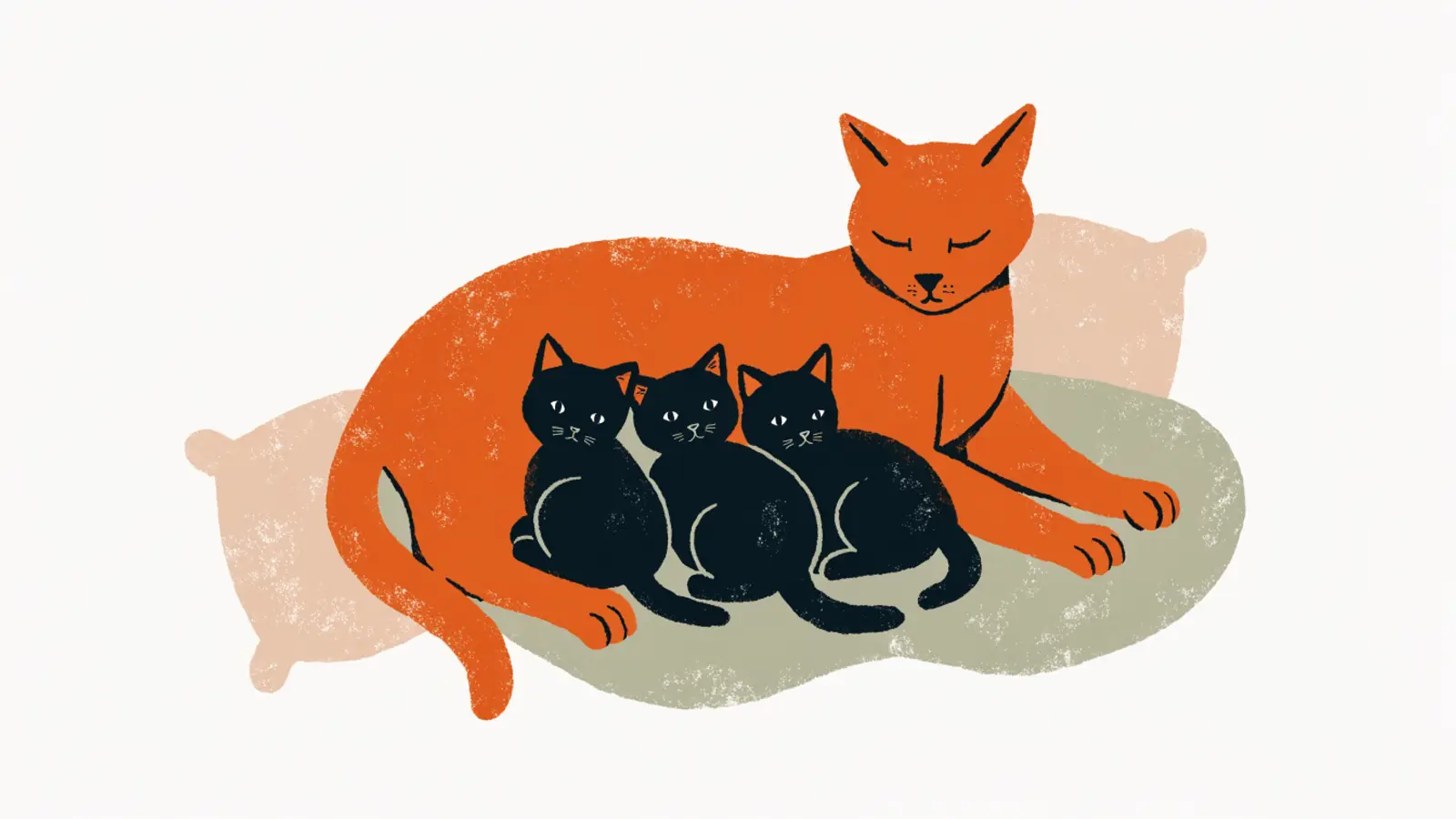
Birth to 6 weeks
Maternal antibodies protect the kitten. WSAVA starts the core vaccine no earlier than 6 weeks, and live vaccines are contraindicated under 4 weeks.
6-8 weeks
First dose of the combination vaccine against panleukopenia, herpesvirus and calicivirus.
9-12 weeks
Second core dose 2-4 weeks after the first. From 8 weeks, after a negative test, the FeLV series can start.
12 weeks (3 months)
In Russia rabies vaccination is given from this age. If the series started at 6-8 weeks, the next core dose and the second FeLV dose often fall here too.
16 weeks and older
Last dose of the primary series. In high-risk settings WSAVA allows continuing to 20 weeks at 2-3 week intervals.
26 weeks (about 6 months)
Core booster per WSAVA 2024, aimed at kittens that still had maternal antibodies at 16 weeks.
12-16 months
Booster at one year in clinics that keep the older schedule. The FeLV booster is due one year after the last series dose, and rabies is repeated yearly.
From 3 years
A low-risk cat gets the core vaccine every 3 years. Cats that go outdoors, to shows or into boarding are revaccinated more often, up to yearly.
The number of doses depends on when the series starts and on the interval. Starting at 8 weeks with a 4-week gap gives 8, 12 and 16 weeks. Starting at 6 weeks with a 3-week gap gives 6, 9, 12 and 15 weeks, plus one more dose after 16 weeks. The sources disagree slightly on the gap: the WSAVA text says 2-4 weeks, while the WSAVA table and the AAHA/AAFP guidelines say 3-4 weeks, keeping 2-3 weeks for high-risk situations.
For a kitten over 16 weeks or an adult cat with no vaccination history, WSAVA advises two core doses 2-4 weeks apart. One dose of a live vaccine will protect many cats, but not all. AAHA/AAFP allows one or two doses depending on the vaccine type.
Pregnant cats are not given live vaccines; AAHA/AAFP cites a theoretical risk of cerebellar underdevelopment in the kittens. WSAVA considers inactivated vaccines safer in pregnancy, but whether to vaccinate at that point is the vet's call.
Booster at 6 months or at one year
WSAVA 2024 recommends a dose at 26 weeks or later rather than waiting until 12-16 months. A small share of kittens still cannot respond at 16 weeks because of maternal antibodies, and with a booster only at one year they would stay unprotected for months. WSAVA bases this on studies that found such long-lasting maternal antibody interference. The dose does not replace the health check at one year.
AAHA/AAFP 2020 also suggests considering a booster at 6 months and points out the side effect: FeLV and rabies shots at one year then need a separate visit. The Cornell Feline Health Center, citing the US Feline Veterinary Medical Association, recommends a booster at one year. Both options are in use, and the choice depends on the clinic and on the risk for a given kitten.
For adult cats, WSAVA says immunity from most modern live core vaccines lasts many years, so low-risk cats get them no more often than every 3 years. High-risk cats, for example before boarding or a show, are boosted up to yearly and 1-2 weeks before exposure. AAHA/AAFP gives 7-10 days before boarding. Intranasal vaccines are repeated every year.
A vaccine leaflet may call for yearly boosters. WSAVA explains that the leaflet states the minimum duration of immunity the manufacturer has proven, while guidelines draw on all published data. A vet may vaccinate less often than the leaflet says with the owner's informed consent, unless local rules require strict label use. Rabies vaccination in Russia follows the veterinary rules, not these recommendations.
Does an indoor-only cat need vaccines
Yes, at least the core ones. The Cornell Feline Health Center recommends the combination vaccine for all cats, including those that never go outside or meet other cats. Panleukopenia virus is very hardy: without proper disinfection it survives indoors for many months, upwards of a year, and outdoors it survives freezing. It travels on bedding, litter boxes, bowls, toys, and people's hands and clothing.
AAHA/AAFP lists how an indoor cat gets exposed: from other cats in the household that carry infection without signs, through virus on the owner's shoes and clothes, and during clinic visits. The same guidelines note that strictly indoor cats may in theory be more susceptible to panleukopenia and calicivirus, because they never meet the virus naturally and miss that natural boost to immunity.
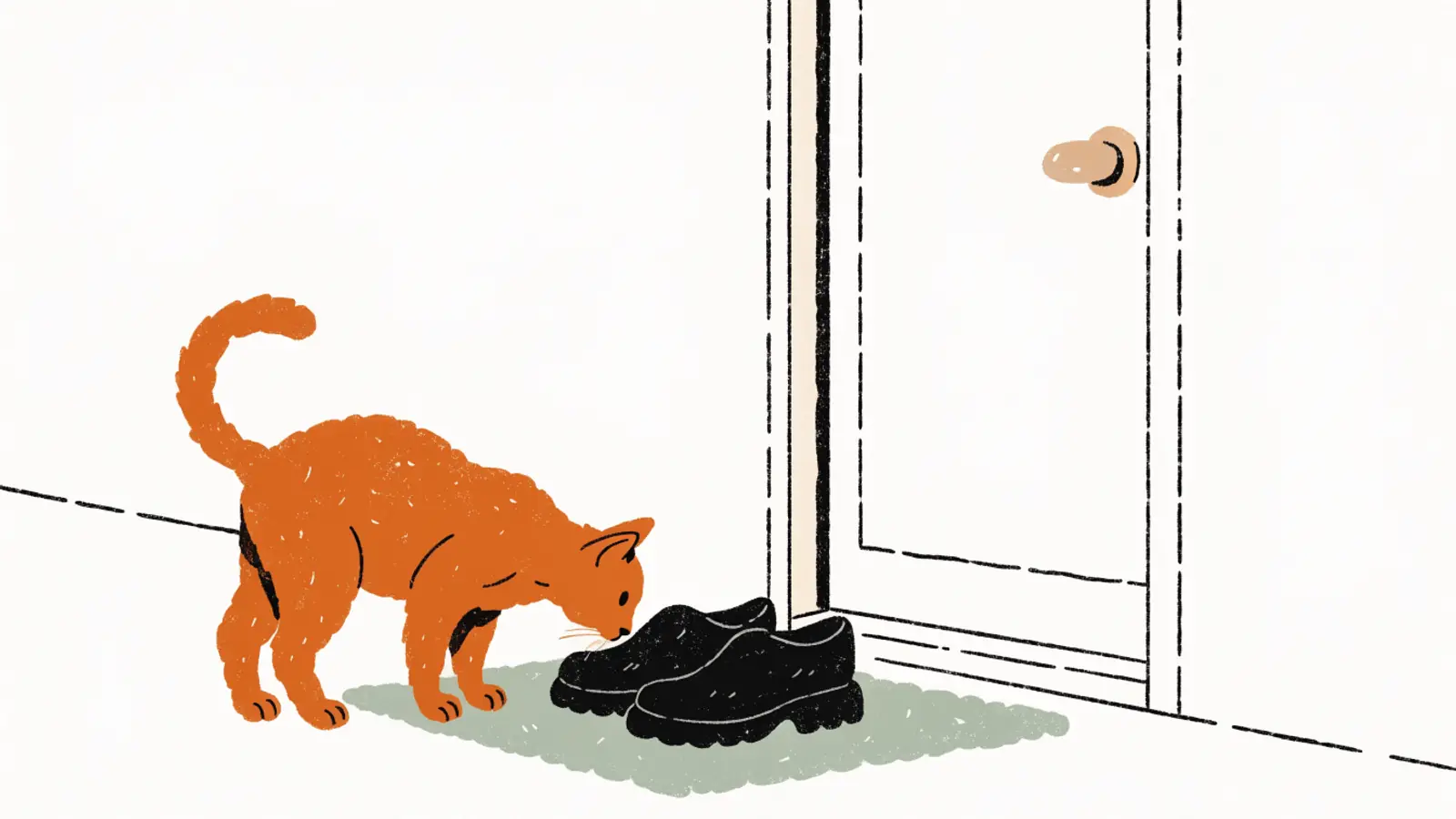
Russian rabies rules do not exempt indoor cats: they cover all domestic animals of the cat family. FeLV vaccination for an adult cat that lives alone and has no contact with other cats is usually rated low risk, and WSAVA calls avoiding contact with infected cats the best protection against FeLV. For kittens under one year, cats that might escape, and homes that take in new cats, a vet may still recommend the FeLV series.
Do cats in Russia need a rabies shot
Yes, and it is the owner's obligation. Russia's veterinary rules on rabies were approved by Order No. 705 of the Ministry of Agriculture of 25 November 2020 and apply from 1 March 2021 to 1 March 2027. Under clause 8, animals of the dog and cat families are vaccinated by veterinary specialists "according to the instructions for use" of the vaccines. The order itself names no age or interval; the vaccine leaflets set them.
In its guidance for owners, Rosselkhoznadzor, the federal veterinary and phytosanitary service, describes a yearly rabies shot from 3 months of age, recorded in the pet passport. According to Rospotrebnadzor, state veterinary stations give the rabies vaccine free of charge.
The passport record matters if the cat bites someone. An animal that bites a person or another animal must be brought by its owner to a state veterinary facility within 12 hours for examination and 10 days of observation. After that the cat is vaccinated if it was not vaccinated or if 180 days or more have passed since the last shot, and it is kept isolated for another 30 days. Travel deadlines, passport entries and vaccine details are covered in a separate article on rabies vaccination.
Injection-site sarcoma: where cats should be vaccinated
Feline injection-site sarcoma (FISS) is a malignant connective tissue tumour that develops where an injection was given. The Merck Veterinary Manual puts it at 1-16 cases per 10,000 vaccinations. The European Advisory Board on Cat Diseases (ABCD) cites 1-4 cases per 10,000 vaccinated cats in the USA and a much lower rate in the UK: in 2007, roughly 1 case per 5,000-12,500 vaccination visits. The tumour can appear as early as 4 months or as late as 2-3 years after the injection. Vaccines are not the only injections that can cause it.
According to WSAVA, the sarcoma risk is far smaller than the benefit of vaccination, and that no vaccine is clearly completely safe. Some evidence points to adjuvanted vaccines, and WSAVA advises choosing non-adjuvanted ones where there is a choice. The AAHA/AAFP task force considers that evidence too weak to prefer one vaccine type. WSAVA also states that an adjuvanted vaccine is much better than no vaccine at all.
Injection sites the guidelines recommend
- No subcutaneous injections into the scruff between the shoulder blades. Tumours there are found late and often cannot be fully removed. WSAVA, AAHA/AAFP and ABCD all avoid this site, and ABCD adds the side of the chest wall.
- Vaccines go under the skin rather than into muscle where the law allows: a subcutaneous tumour is found sooner.
- WSAVA calls injection as low on a limb as possible, preferably below the knee, the gold standard. AAHA/AAFP explains why: if a sarcoma forms, the limb can be amputated with 5 cm of healthy tissue around it. North America adopted "leukaemia left hind leg, rabies right hind leg".
- A 2014 study of injections near the tip of the tail found a good immune response and good tolerance, but WSAVA and AAHA/AAFP consider the data still thin.
- The site changes every time and is recorded in the medical record or passport, ideally on a diagram showing which vaccine went where.
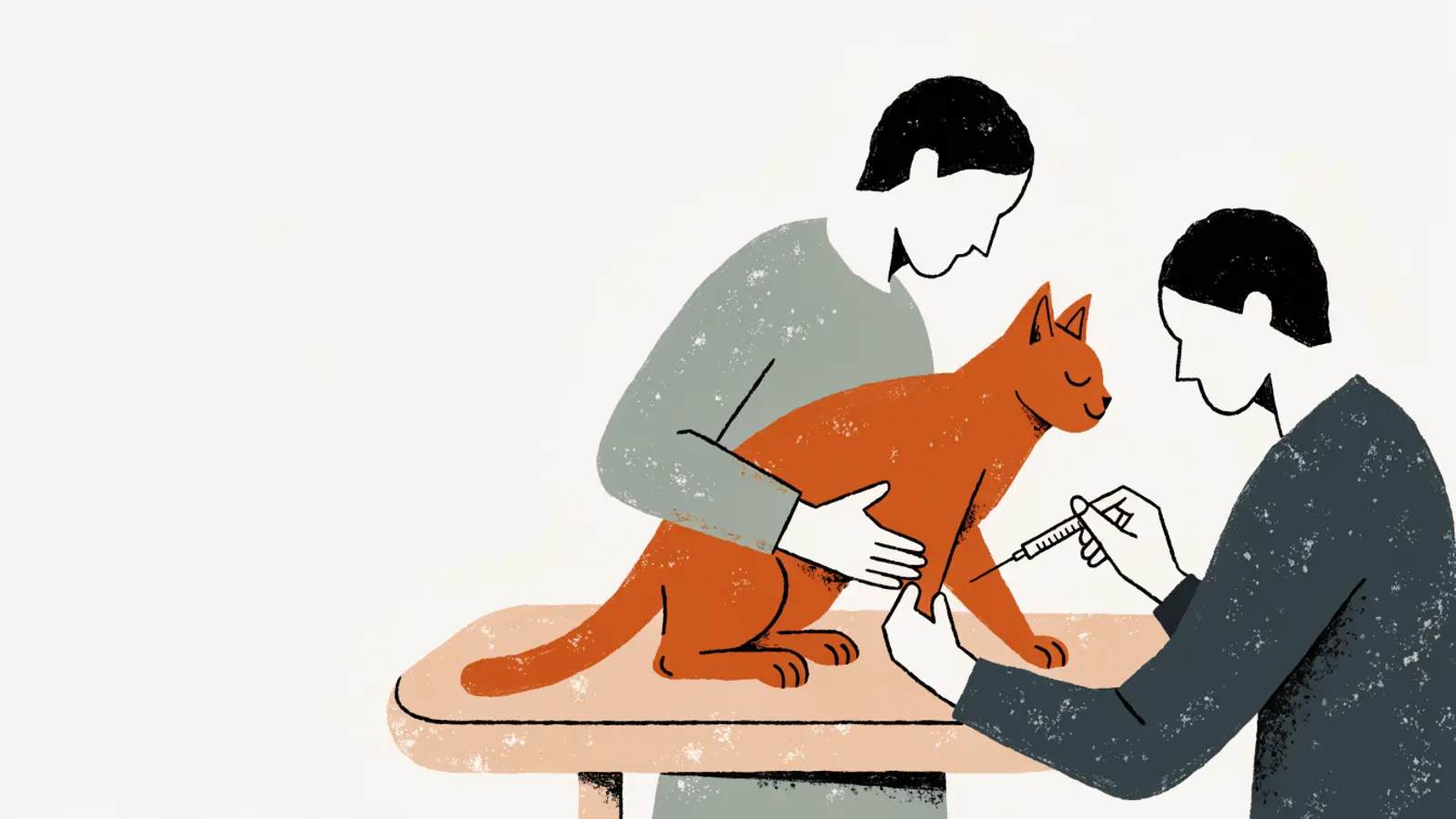
Not every vet uses limb sites. WSAVA notes that in countries where the sarcoma is rarer than in North America, vets are reluctant to inject into legs. One local guidelines group recommended injecting 4 cm to the side of the spine's midline, over the shoulder muscle, where a tumour shows up earlier than in the scruff. WSAVA still regards the lower limb as the best option.
The 3-2-1 rule
A small lump after an injection is common and usually goes away. ABCD and AAHA/AAFP use a simple rule: a lump at the vaccination site is removed and examined under a microscope if it is still there 3 months after the shot, if it is larger than 2 cm across, or if it is still growing a month after the injection.
If a lump at the injection site has not gone after 3 months, is larger than 2 cm, or keeps growing a month after the shot, take the cat to a vet. Such a lump needs a biopsy, not more waiting.
How to keep track of a cat's vaccinations
After each shot it helps to note a few things. The date and which diseases the vaccine covers. The vaccine type, live, inactivated or intranasal, since the interval depends on it. The injection site, which WSAVA asks for explicitly. The FeLV test result, if one was done. And the date of the next shot your vet gave.
- For a kitten: dates of every primary dose and of the booster at 26 weeks or one year.
- For an adult cat: the next core vaccine date on the interval agreed with the vet, yearly or every 3 years.
- Rabies every year, with an entry in the pet passport.
- Before boarding, a show or a move: check dates 2-3 weeks ahead so the shot can be given 1-2 weeks before.
- A lump after a shot: the date you noticed it and its rough size, so the 3-2-1 rule can be applied.
In faunely vaccinations can be set up as recurring procedures, and the app sends a booster reminder in Telegram.
Common questions
At what age does a kitten get its first vaccination?
At 6-8 weeks. WSAVA does not recommend starting the core vaccine before 6 weeks, and live vaccines are contraindicated under 4 weeks. Doses are then repeated every 2-4 weeks until 16 weeks or older.
How many shots does a kitten need in its first year?
Usually 3-4 core doses up to 16 weeks and one booster at 26 weeks or one year. Add a rabies shot from 3 months and, if the vet recommends it, two FeLV doses 3-4 weeks apart after a test. The exact count depends on the starting age and the interval chosen.
Does an indoor cat need a rabies vaccine?
Yes. Russia's rabies rules cover all domestic cats and make no exception for indoor-only cats. Rosselkhoznadzor describes a yearly shot from 3 months of age.
How often should an adult cat be vaccinated?
WSAVA recommends the core vaccine every 3 years for a low-risk cat, and more often, up to yearly, for cats that go outdoors, into boarding or to shows. Rabies is given yearly in Russia. The FeLV interval depends on risk and on the vaccine leaflet.
What if a booster was missed?
Book a vet visit and get the shot soon; the vet decides whether the series has to restart. For cats over 16 weeks with no known history, WSAVA advises two core doses 2-4 weeks apart. If the rabies shot has lapsed, the cat formally counts as unvaccinated until a new passport entry.
Can a pregnant cat be vaccinated?
Not with live vaccines: WSAVA and AAHA/AAFP advise against them in pregnant cats because of the risk to the kittens. WSAVA considers inactivated vaccines safer during pregnancy. The vet decides after an examination.
Keep the schedule in faunely
Add your pet, mark what has been done, and faunely will remind you about the next step in Telegram.
Start a pet diarySources
- 2024 guidelines for the vaccination of dogs and cats. WSAVA, Journal of Small Animal Practice
- Core and non-core vaccines for pet cats (table). WSAVA
- 2020 AAHA/AAFP Feline Vaccination Guidelines. AAHA/AAFP, Journal of Feline Medicine and Surgery
- Update on Feline Injection-Site Sarcomas. AAHA
- Guideline for feline injection-site sarcoma. European Advisory Board on Cat Diseases (ABCD)
- Injection site sarcoma, cat. Merck Veterinary Manual
- Feline Panleukopenia Virus. Cornell Feline Health Center
- Order No. 705 of 25.11.2020 (veterinary rules on rabies). Ministry of Agriculture of Russia, Rosselkhoznadzor
- Dogs and cats must be vaccinated against rabies. Rosselkhoznadzor
- Rabies vaccination for pets. Rospotrebnadzor Federal Centre for Hygiene and Epidemiology
More articles
- Rabies vaccination for dogs and cats in Russia: timing, legal duty, paperworkWhether Russian Order No. 705 makes the rabies shot mandatory, the age for the first dose, booster interval, pet passport entries and when titers are needed.
- Normal cat weight by age and breedAdult and kitten weights by month, British Shorthair, Scottish Fold and Maine Coon figures, the WSAVA body condition score and safe weight loss.
- Flea and tick treatment for dogs and cats: how often and whenHow often to treat dogs and cats for fleas and ticks, when to start in spring in Russia, the babesiosis risk, and why dog spot-ons can kill cats.