

faunely editorial team · Updated · 15 min read
In short
There is no single healthy weight in kilograms for all cats. The Merck Veterinary Manual gives the average ideal weight of an adult domestic cat as about 2.8 kg for females and 3.2 kg for males, and large breeds such as the British Shorthair and Maine Coon are normally heavier. The WSAVA 9-point body condition score tells you more than the scale: at the ideal score of 5, the ribs can be felt under a thin layer of fat and there is a waist behind them. A kitten weighs about 100 g at birth and roughly 0.9 kg at 8 weeks, and a mixed-breed cat usually stops growing by about 7 months.
How much should an adult cat weigh
It depends on what you count as normal. The Merck Veterinary Manual lists the average ideal weight of a mature domestic cat as 3.2 kg for males and 2.8 kg for females. That is the weight of a cat carrying no excess fat.
Cats seen in clinics are heavier on average. Campigotto and colleagues (JAVMA, 2019) analysed almost 53 million weight records from 19 million cats at clinics in the US and Canada. In mixed-breed cats, mean weight kept rising until 8 years and peaked at 6.1 ± 1.6 kg in neutered males, 5.7 ± 1.8 kg in intact males, 4.9 ± 1.4 kg in spayed females and 4.6 ± 1.6 kg in intact females. A spread of about a kilogram and a half either way is normal. The study did not record body condition, so overweight cats are part of those averages.
Breed figures come from cat fancy registries. The show standards of TICA, CFA and WCF generally do not set a weight; they describe size in words such as "medium" or "medium to large". TICA gives weights in its breed introductions, and those are ranges, not requirements.
| Cat | Females | Males | Source |
|---|---|---|---|
| Mixed breed, ideal weight | about 2.8 kg | about 3.2 kg | Merck Veterinary Manual |
| Mixed breed, mean clinic weight at 8 years | 4.6-4.9 kg | 5.7-6.1 kg | Campigotto et al., 2019 |
| British Shorthair | 3.6-5 kg | 4.5-7.3 kg | TICA |
| Scottish Fold | 3.2-4.5 kg, not split by sex | 3.2-4.5 kg, not split by sex | TICA |
| Maine Coon | 5.4-6.8 kg | about 8-10 kg | TICA |
A cat heavier than the table is not automatically obese, and a lighter one is not automatically lean. A big-boned male can be in ideal shape at 6 kg while a small-framed female is already overweight at 4.5 kg. That is why vets read the scale together with a body condition score.
How to check your cat's body condition by hand with the WSAVA score
The WSAVA Global Nutrition Committee uses a 9-point Body Condition Score for cats. A score of 1 is emaciated, 5 is ideal and 9 is severely obese. The WSAVA chart cites the studies that validated the scale, by Laflamme (1997) and Bjornvad and colleagues (2011). The check takes about a minute and uses your eyes and the flat of your hands.
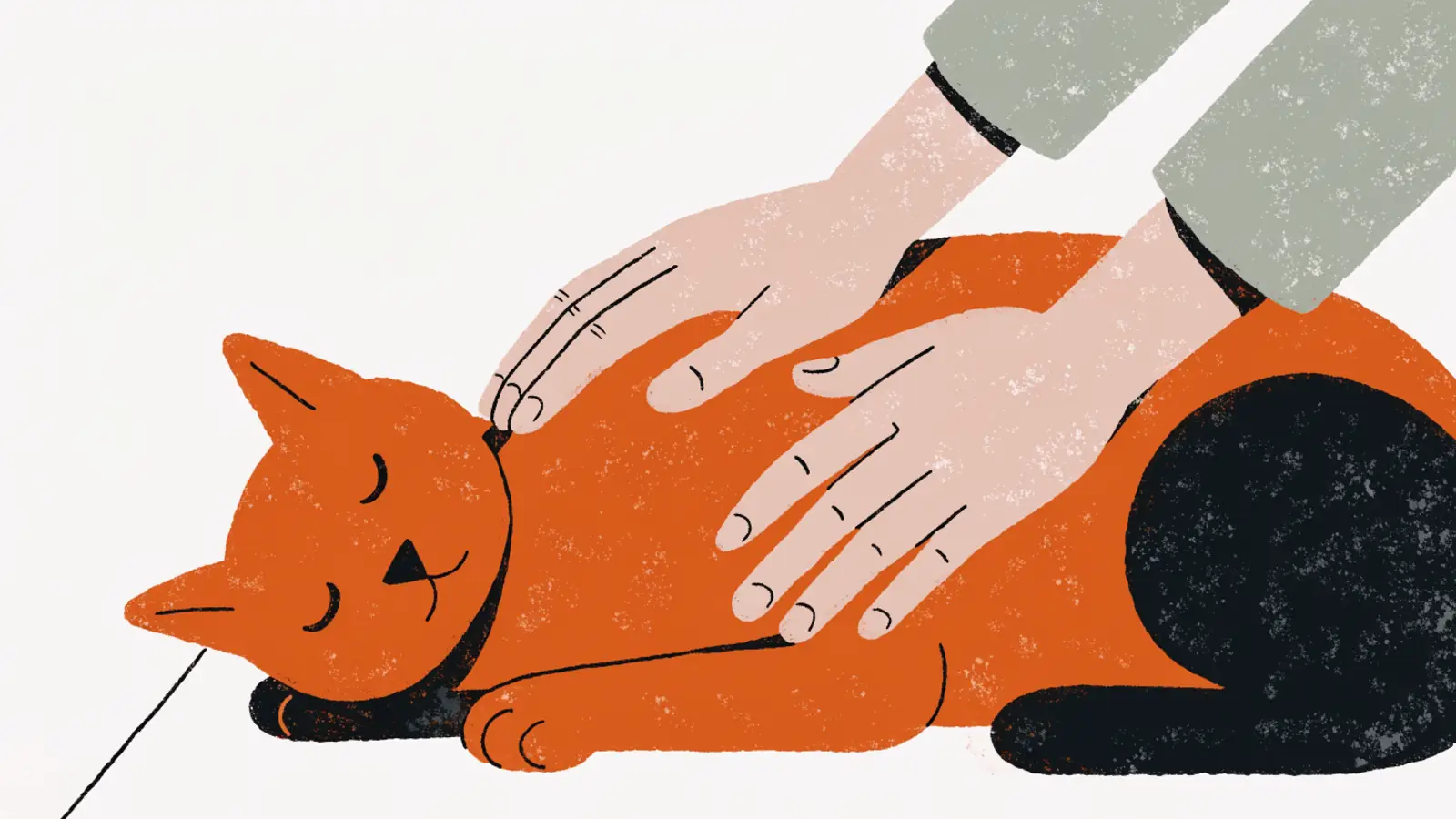
- Run your palms along both sides of the chest with light pressure. At a score of 5 the ribs can be felt under a thin layer of fat. If they are easy to count with almost no fat over them, the score is 4 or lower; if you have to search for them through fat, it is 7 or higher.
- Look down at the cat from above. There should be a waist behind the ribs, without a sharp tuck. At 7 the waist is hard to see, and at 8 it is gone.
- Look from the side and feel the lower belly. A cat in ideal shape has a minimal abdominal fat pad. At 6 the pad can be felt, at 8 the belly is visibly rounded and fat also builds up over the lower back.
- Check the lower back and hips. Visible lumbar vertebrae, prominent pelvic bones and a severe abdominal tuck match scores 1 to 3.
In a longhaired cat the coat hides both the waist and any protruding bones, so the score relies mostly on touch. The WSAVA descriptions of visible ribs refer to shorthaired cats.
| Score | What you see and feel | Assessment |
|---|---|---|
| 1 | Ribs, lumbar vertebrae and pelvic bones easily seen, no fat, severe abdominal tuck | Emaciated |
| 2-3 | Ribs visible on shorthaired cats or easily felt, lumbar vertebrae obvious, marked waist | Thin |
| 4 | Ribs felt under minimal fat, noticeable waist, slight abdominal tuck | Below ideal |
| 5 | Well proportioned, ribs felt under a slight fat covering, waist visible but not pronounced, minimal abdominal fat pad | Ideal |
| 6 | Ribs felt under slight excess fat, waist and belly fat pad present but not obvious | Just above ideal; WSAVA notes it may be acceptable in some cats, especially older ones |
| 7 | Ribs hard to feel, waist hard to see, belly may be slightly rounded | Overweight |
| 8-9 | Ribs cannot be felt, no waist, belly rounded or distended, fat over the lower back, and at 9 also on the face and legs | Obese |
Kitten weight by month: chart
A newborn kitten weighs about 90-100 g (Merck Veterinary Manual). For the first 3-4 months it grows very fast, gaining 50-100 g a week. Growth then slows: according to Merck it begins to plateau at 150-160 days and is usually complete by 200-220 days.
Measured weights up to 8 weeks come from DiGangi and colleagues (Journal of Feline Medicine and Surgery, 2019), who weighed 246 colony domestic shorthair kittens every two weeks. For older kittens the same paper tested a shelter medicine rule of thumb: a kitten gains about 0.45 kg (1 lb) for each month of age. Up to 10 weeks the rule put most kittens within a week of their true age; after that it was wrong more and more often.
| Age | Weight | Source |
|---|---|---|
| Birth | 110 g on average, mostly 90-130 g | DiGangi et al., 2019; Merck |
| 2 weeks | about 300 g | DiGangi et al., 2019 |
| 4 weeks | about 480 g | DiGangi et al., 2019 |
| 6 weeks | about 660 g | DiGangi et al., 2019 |
| 8 weeks | about 920 g: males 960 g, females 880 g | DiGangi et al., 2019 |
| 3 months | about 1.4 kg | 0.45 kg per month of age rule |
| 4 months | about 1.8 kg | same rule, less accurate |
| 5-7 months | gain slows and levels off | Merck: plateau at 150-160 days |
| 7-12 months | a mixed-breed cat has usually finished growing and is close to adult weight | Merck: growth complete by 200-220 days |
From 6 weeks males are heavier than females on average; at 8 weeks the gap in the DiGangi data was about 80 g. The chart describes mixed-breed kittens. A Maine Coon kitten, whose adult weight is roughly double, will be above these figures, and that is no reason to cut its food.
If a kitten stops gaining weight or loses weight, take it to a vet without delay. The younger the kitten, the smaller its reserves and the faster it deteriorates.
When does a cat reach adult weight
A mixed-breed cat stops growing at around 7 months, or 200-220 days according to Merck. By one year its weight is usually close to adult. In the Campigotto clinic data, mean weight then kept creeping up until 8 years and only declined after that. Skeletal growth is over by the first birthday, so weight gain in an adult cat is checked against its body condition score.
Large breeds take longer. TICA says Maine Coons usually do not reach full maturity until 4 years of age; a healthy adult male of the breed weighs around 8-10 kg and a female 5.4-6.8 kg. A one-year-old Maine Coon below those figures is still growing.
Many cats lose weight after their peak. WSAVA accepts a score of 6 out of 9 in older cats. Weight loss without a change in diet should be checked by a vet at any age.
Normal weight for British Shorthair and Scottish Fold cats
According to TICA, British Shorthair females weigh 3.6-5 kg (8-11 lb) and males 4.5-7.3 kg (10-16 lb). Elsewhere on the same page TICA gives an overall range of 9-18 lb, about 4.1-8.2 kg, and adds that the weight should come from muscle, not from extra food. The page also notes that British Shorthairs love food and are not very active, so their portions need watching.
TICA describes the Scottish Fold as a medium-sized cat of 3.2-4.5 kg (7-10 lb), with no separate figures for males and females. TICA covers the folded and straight-eared varieties in one standard, so the same range applies to Scottish Straights.
Scottish Folds have an extra reason to stay lean. TICA warns that they can develop tail stiffness that is painful if the tail is handled roughly. Obesity in cats is linked to orthopaedic disease (Larsen, 2016), and a cat with stiff joints does not need the extra load.
Why cats gain weight after neutering
Cats put on weight more easily after neutering or spaying. In her review (JFMS Open Reports, 2016), Larsen names increased food intake as the most likely cause. In one study she discusses, the calories needed to maintain weight fell by 16% in spayed females between 4 and 16 weeks after surgery, with no significant change in neutered males over the same period. In another, kittens neutered during growth were 24% heavier than their intact littermates by one year of age.
Cats fed freely after surgery almost always gain weight, and restricting portions prevents it. Some cats need their food cut by as much as 50% to hold their pre-surgery weight. Larsen suggests reducing energy intake by at least 11% after neutering and being prepared for a cut of more than 30%. The actual portion is set with a vet based on weight and body condition.
It helps to record the weight on the day of surgery and compare later weigh-ins with it: the scale shows a gain before the cat's outline changes.
How common is obesity in cats and why it matters
Larsen's review cites studies in which up to 63% of cats in some populations were overweight or obese. Neutering remains the main known risk factor, especially in males.
Overweight cats are more likely to develop diabetes mellitus, constipation, orthopaedic disease, altered blood clotting, urinary tract disease and skin disease. Larsen lists hepatic lipidosis among these conditions as well.
On the WSAVA scale, overweight starts at 7 and obesity covers 8 and 9. For a cat that weighs 6 kg with an ideal weight of 4.5 kg, the excess is a third of its body weight.
Why fast weight loss is dangerous for cats
A cat that stops eating, or is put on a diet that is too strict, risks hepatic lipidosis. It is the most common acquired liver disease in cats and can be fatal (Merck Veterinary Manual). During starvation, fat from body stores reaches the liver faster than the liver can use it, and liver cells fill up with triglycerides. The setting for the disease is loss of appetite in an overconditioned cat.
Among the causes of appetite loss, Merck specifically names forced weight loss with a switch to food the cat will not accept. The same list includes moving house, a new pet, boarding, and a cat accidentally shut in somewhere without food.
The 2014 AAHA guidelines set the target rate of weight loss in cats at 0.5-2% of body weight per week. For a 6 kg cat that is 30-120 g a week. AAHA advises against cutting calories below 60% of the resting energy requirement for ideal weight: harsher restriction raises the risk of nutrient deficiencies and, in cats, of hepatic lipidosis. If weight is coming off faster than the target, the guidelines recommend adding 10% more calories.
An overweight cat that has stopped eating needs a vet without waiting. Signs of hepatic lipidosis listed by Merck include marked weight loss (usually more than 25%), lethargy, vomiting, drooling and jaundice.
How to weigh a cat at home
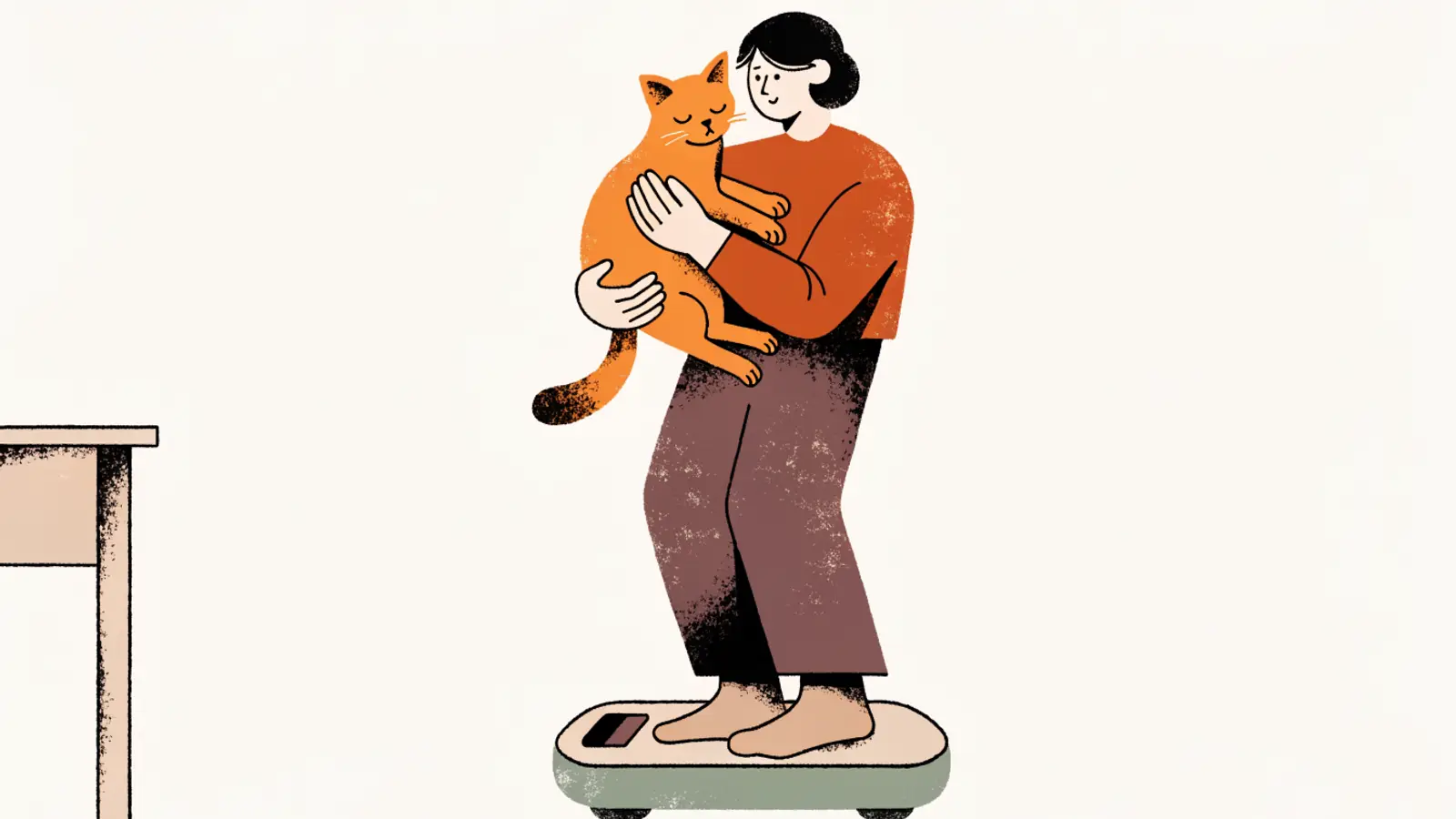
The easiest way is to weigh yourself with the cat in your arms and then without it. The difference between the two readings is the cat's weight.
- Put the bathroom scale on a flat, hard floor.
- Step on the scale without the cat and write down the reading.
- Pick the cat up, supporting its chest and hind legs, and step on the scale again.
- Subtract the first number from the second.
- Next time, use the same scale at the same time of day, for example before the morning meal.
Bathroom scales usually read in 100 g steps, which is too coarse for a kitten. Kittens are easier to weigh in a bowl on a kitchen scale. An adult cat that will not stay in your arms can be weighed in its carrier: first the empty carrier, then with the cat inside.
A single weigh-in tells you little. AAHA tracks weight change as a percentage per week: the loss since the last weigh-in is divided by the previous weight, multiplied by 100 and divided by the number of weeks between weigh-ins. That takes at least two dated records.
How to keep a cat weight chart
For each entry, write down the date, the weight and the WSAVA body condition score. A kitten is easy to weigh weekly: with a normal gain of 50-100 g a week, a stall in growth shows up at once. If your cat is losing weight on a vet's plan, AAHA recommends a check every two weeks until the target rate is established, then monthly until the goal weight is reached.
A chart shows what scattered numbers hide: the slow climb after neutering, a plateau during a diet, or weight loss the owner has not noticed. Mark the neutering date, food changes and illnesses next to the entries so you can link them to the changes later. In faunely, weight is stored in the pet's profile and plotted as a chart, and regular weigh-ins can be set up as a recurring task with a Telegram reminder.
Common questions
How much should a cat weigh at 1 year?
A mixed-breed cat has usually finished growing by one year and is close to its adult weight. The average ideal weight given by Merck is about 2.8 kg for females and 3.2 kg for males, and many healthy cats weigh more. Maine Coons are still growing at a year: TICA puts their full maturity at 4 years.
How much does a kitten weigh at 2 and 3 months?
At 8 weeks a kitten weighs about 0.9 kg on average (DiGangi et al., 2019), and at 3 months about 1.4 kg by the rule of 0.45 kg per month of age. After 10 weeks that rule becomes less reliable. Being 100-200 g off is not a problem in itself if the kitten is active and gaining steadily.
What weight counts as obese for a cat?
Obesity is defined by body condition, not kilograms: on the WSAVA scale it is a score of 8 or 9 out of 9, when the ribs cannot be felt under fat and there is no waist. A score of 7 means overweight. The number on the scale depends on the cat's size and breed.
How much does a British Shorthair weigh?
According to TICA, adult British Shorthair females weigh 3.6-5 kg and males 4.5-7.3 kg. The same TICA page also gives a wider overall range of about 4.1-8.2 kg. The show standard sets no weight, and any extra kilograms on a British Shorthair should be muscle rather than fat.
How much does a Scottish Fold weigh?
TICA gives 3.2-4.5 kg for the Scottish Fold without splitting by sex and calls it a medium-sized cat. The same range suits straight-eared Scottish cats. TICA warns that the breed can develop painful tail stiffness, so extra load on the skeleton is best avoided.
Can I put my cat on a crash diet?
No. Sharply restricting food in an overweight cat can trigger hepatic lipidosis, a dangerous liver disease. AAHA recommends a loss of 0.5-2% of body weight per week and no fewer calories than 60% of the resting energy requirement for ideal weight. A weight loss plan should be made with a vet.
Keep the schedule in faunely
Add your pet, mark what has been done, and faunely will remind you about the next step in Telegram.
Start a pet diarySources
- Body Condition Score: Cats. WSAVA Global Nutrition Committee
- Feeding Practices in Small Animals. Merck Veterinary Manual
- Assessment of body weight for age determination in kittens. Journal of Feline Medicine and Surgery (DiGangi et al., 2019)
- Investigation of relationships between body weight and age among domestic cats stratified by breed and sex. JAVMA (Campigotto et al., 2019)
- British Shorthair. The International Cat Association (TICA)
- Scottish Fold. The International Cat Association (TICA)
- Maine Coon. The International Cat Association (TICA)
- Risk of obesity in the neutered cat. JFMS Open Reports (Larsen, 2016)
- 2014 AAHA Weight Management Guidelines for Dogs and Cats. American Animal Hospital Association
- Feline Hepatic Lipidosis. Merck Veterinary Manual
More articles
- Rabies vaccination for dogs and cats in Russia: timing, legal duty, paperworkWhether Russian Order No. 705 makes the rabies shot mandatory, the age for the first dose, booster interval, pet passport entries and when titers are needed.
- Vaccination schedule for kittens and adult catsFirst kitten shot at 6-8 weeks, boosters to 16 weeks, revaccination at 6 or 12 months. Rabies in Russia, FeLV, indoor cats, injection sites.
- Flea and tick treatment for dogs and cats: how often and whenHow often to treat dogs and cats for fleas and ticks, when to start in spring in Russia, the babesiosis risk, and why dog spot-ons can kill cats.